
Put soil first — a quick note to anchor this piece for readers.
Put soil first: Quick notes
Soil improvement is the least glamorous job in the garden.
It’s easier to dream about flowers than to think about mulches and compost.
But without healthy soil, you won’t get so many flowers.
This year, there’s been a big shift in our attitude towards soil. At the Garden Press Event in London — where horticultural companies unveil the ideas and products that shape the next gardening season — soil improvement was everywhere.
There were more innovations in mulch and compost than I’ve ever seen. Phrases like “regenerative gardening” and “anaerobic digester” emerged from the small print of technical jargon to take centre stage. And bacteria and funghi are no longer linked to the words ‘how to get rid of…’ These are the future.
So what does this new language of soil improvement actually mean for your garden?
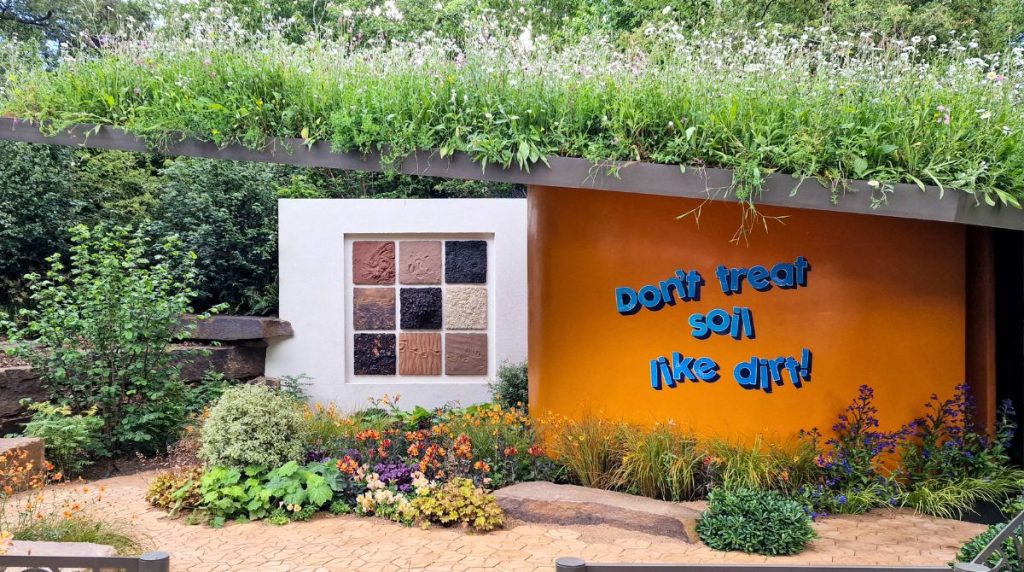
Don’t treat soil like dirt! Garden designer Juliet Sargeant’s show garden at RHS Chelsea Flower Show was an early call for a new approach to soil improvement. Juliet’s book Start with Soil is now out.
Note: Amazon links are affiliate, see disclosure. Other links are not affiliate.
What’s the difference between mulch and fertilizers?
For years, expert gardeners have been saying ‘mulch feeds the soil, fertilizer only feeds individual plants.’
When I first started gardening, I was lucky enough to be given the best advice ever: ‘Just weed and mulch.’ I spent my first year as a gardener just weeding and mulching, getting to know my garden and – without knowing it – improving my soil.
For more beginner gardening tips, see The Basics Of Gardening.
The reason why mulch is better for your soil than fertilisers is that traditional fertilisers contain nitrogen and phosphorus, which are often washed into our waterways. This contaminates the water, causing issues like algae bloom and reduced oxygen in the water, affecting the plants and wildlife in that water.
Once a plant has taken up a fertilizer or the fertilizer has been washed away, that’s the end of its usefulness.
Fertilizers are useful for very fast-growing or ‘hungry’ crops, such as vegetables and roses. But sprinkling fertilizer all over your border is unnecessary and doesn’t do much good in the longer term.
Mulches aren’t washed away or used up so quickly. They are incorporated into the soil over time.
There’s now a move towards using organic ingredients in fertilizers, so that there’s less chemical run-off, including
What organic mulches do for your soil and your plants:
- Mulch is slowly worked into the soil by worms and micro-organisms to improve soil structure
- This increases the amount of water the soil holds, so you have to water less (see how to save time, effort and money when watering your garden).
- The mulch feeds the microbial and fungal life that a healthy soil needs
- When mulch breaks down, the nutrients are released slowly for plants to take up over a period of time.
For decades, soil has often been treated as a backdrop. In 2026, it looks as though we are finally beginning to treat soil improvement as the most important gardening job of all.
This is partly about the drive towards getting the formulations for peat-free compost right.
And it’s partly about a growing move towards regenerative gardening – the next step on after organic gardening.
What’s the difference between compost and mulch?
In the UK, mulch is a layer that you spread over your borders to discourage weeds and help retain moisture. Some mulches break down to add nutrients and improve the soil structure. Other mulches, such as gravel or rock, just protect the soil and don’t add anything.
Good organic mulches include straw, mushroom compost, well rotted manure and specially formulated mulches.
New mulches at the Garden Press Event
There were several brands of mulch at the Garden Press Event, including:
- Thompson & Morgan’s Incredimulch – a wood fibre mulch with a slow-release feed. It uses exclusive chemical-free fusion technology to lightly bind together when watered, so no blowing, shifting or scattering.
- Marvellous Mulch made from chopped dust extracted from straw (a recycled organic fibre and agricultural by product) enhanced with natural seaweed.

Compost or mulch? Both are brilliant for soil improvement but they do slightly different things.
Compost is what you put in pots or add to a planting hole in order to plant plants.
UK and US gardeners have been very reliant on peat-based composts in the last fifty years. However, with peat a declining resource, the search is on for good peat-free composts.
In countries that have never used peat-based composts, such as Australia, they don’t see the problem in establishing good alternatives. However Australia has easier access to coir byproducts whereas coir has to travel a long distance to reach the UK.
Peat-free compost formulations at the Garden Press Event included
- Durston’s Advanced Compost range: Based on renewable ingredients, such as wood-based Gro Fibre with added organic nutrients and a wetting agent to balance water absorption, aeration and drainage. New this year is a peat-free houseplant compost.
- Treasure Gardening’s Wonderfuel: a compost blend of green compost, coir, a by-product of the coconut industry, wood fibre from furniture off-cuts, a by-product of the furniture industry and composted bark sourced from UK forestry.
- Field Composts – their No.7 Seed Compost. A perfected recipe and finely graded to 4mm, this mix is for germinating seedlings and for the early establishment of young plants as well as their Field No.4 Organic Fine Grade Lawn Dressing.
- Westland Enriched Organic Gold planting compost has added Carbon Gold biochar, a charcoal product that improves soil structure and aeration
- Miracle-Gro All Purpose Peat Free Compost
Garden compost is what you make when you pile up all your garden clippings and they break down into a soil-like substance. Garden compost is sometimes called ‘Gardeners’ Gold.’ It returns nutrients to your soil and is free.
See The Really Simple Guide to Making Your Own Compost.
What’s the difference between organic and regenerative gardening?
Organic gardening avoids synthetic fertilizers and pesticides. It’s aimed on preventing harm.
Regenerative gardening goes one step further. It’s a holistic approach with the aim of soil improvement, restoring bio-diversity and sequestering (retaining) carbon in the soil.
Regenerative gardening makes use of mulches over fertilisers. Organic gardeners still use natural-based fertilisers, such as seaweed.
Organic gardeners can be either no-dig/no-till or they can dig traditionally. Regenerative gardeners are no-dig/no-till.
See No Dig For Flower Borders if you want to know more about no dig/no till.
Reflecting the growing interest in organic gardening, Garden Organic has just launched an organic gardening course for both professional and amateur gardeners.
Over-development and over-cultivation can strip the soil of its goodness. And without the soil, we can’t grow the food we eat. Some predictions say that our soil will be too depleted to support the world’s population in fifty years or so. While others disagree, there’s no doubt that healthy soil benefits all living things, including us.
We are at the top of the food chain. So we need to make sure the base of that food chain is healthy!

Compost and mulch are at the heart of regenerative gardening, along with no-dig/no-till and recognising the importance of the right funghi and bacteria.
Anaerobic Digesters: Turning Waste into Soil Nutrition
Another term you’ll need to know: anaerobic digester. Previously used in farming, this is a technology developed to improve agricultural soils, now being adapted for home gardens.
These sealed, oxygen-free systems use microorganisms to break down food waste and agricultural material. The process produces renewable energy and leaves behind nutrient-rich material that can be turned into compost and mulch.
Wildmore Compost began in farming, using surplus straw and vegetable waste processed through anaerobic digestion, providing fuel for 1800 homes. The result is compost designed for soil improvement rather than quick feeding.
MAD Compost (I think MAD stands for Micro Anaerobic Digester) process by-products from local breweries and paper production, as well as “Mad Soldier Frass” — a soil nutrient made from insect frass.
Funghi and Bacteria – why we need them!
If you look up words like ‘fungus’ and ‘bacteria’, you’ll be offered lots of suggestions on ‘how to get rid of…’
Solivita Soil Improver is the first fungi fertiliser for gardens and house plants, after trials in farming and forestry. Made from a mix of fungi, bacteria and natural nutrients, a teaspoon or two can be added to soil and plants, to be absorbed for months, even years. The effect on gardening is deemed to be similar to the boom in human gut nutrition.
This biological focus signals a move away from feeding plants in isolation towards building resilient, living soil systems.
Wool as a Soil Improver
Low-grade wool – such as the dirty bits – has long been used in farming to improve the soil. You can add wool to compost heaps, for example (a great way of disposing of old woollen jumpers!)
Wool breaks down and helps soil improvement in three key ways:
- Adds slow-release nitrogen (so that unused excess doesn’t get washed into waterways)
- Improves soil aeration and structure
- Helps soils hold moisture around roots
Hortiwool showcased its wool garden pads, made from 100% sheep’s wool. These can be used in hanging baskets, around young plants or as mulch. As the wool biodegrades, it releases nutrients and improves moisture retention. When finished, it can be dug into the soil or composted.
These pads can also be used to deter slugs and snails as they form a protective layer around the plant. Nothing, of course, completely deters molluscs, but a wool pad can help give the plants a chance. (See here for more Ways to Beat Slugs and Snails.)
Traditional Garden Growers presented Wooltiliser, wool pellets developed on their Oxfordshire farm. Instead of forcing rapid top growth, it is designed to support soil health first, releasing nutrients gradually across the season.
They developed it with research with the University of Reading, which showed improvements in soil structure, water-holding capacity and microbial activity. It’s a reminder that lower-grade British wool — long undervalued — has always had a place in traditional growing systems. gardeners who find pruning physically demanding, alongside a modular secateur kit that can be dismantled for maintenance.
Pin here to remember new soil improvement trends and products
And do join us. See here for a free weekly email with more gardening tips, ideas and inspiration.

A short mention of Put soil first helps readers follow the flow.










🌸 PS — I appreciate the point about “Soil Improvement: Why 2026 Could Be the” — very helpful. Great share.
Tiny tip – Nice thought — I’ll remember that. Saving it.