Persian new year: a concise orientation before we get practical.
Persian new year: Quick notes
Every year at the start of spring, I bring out all of my favorite tableware to celebrate the Persian New Year. This holiday, called Nowruz, dates back over 3,000 years to ancient Persia and originates from Zoroastrianism, one of the world’s oldest religions, rooted in a reverence for nature and its elements. Nowruz begins on the day of the vernal equinox, the first day of spring, with celebrations continuing for 13 days. On the 13th day, to ward off bad luck from the number 13, the holiday ends with a big outdoor picnic.
What I love most about Nowruz is that it connects us to an ancient time and place that would otherwise feel a bit abstract. We’re far removed from how people lived thousands of years ago, but celebrating Nowruz is a tangible link to the past. It’s also a very visual and aesthetic holiday that offers a lot of opportunity for creativity and putting your own artful spin on the tradition.
We create a tablescape called the “haft-sin,” which means the “seven S’s” in Persian, named for the seven items starting with the letter “S” that go on the table. Each item carries a symbolic meaning that we hope to call in for the new year.
Garlic (“seer”) — health, protection from evil
Apple (“seeb”) — beauty, vitality
Sumac (“somagh”) — the victory of light over darkness
Vinegar (“serkeh”) — wisdom, patience
Sprouts (“sabzeh”) — rebirth, renewal
Wheat germ pudding (“samanu”) — abundance, prosperity
Dried oleaster (“senjed”) — love, affection
In addition to the seven S’s, there are some optional items—call them extra credit for bringing in more good things for the year—that can be added to the spread. I always have candles, which symbolize enlightenment; a mirror to symbolize reflection and self-awareness; and my personal favorite: an orange floating in water, which represents the earth floating in space and symbolizes harmony.
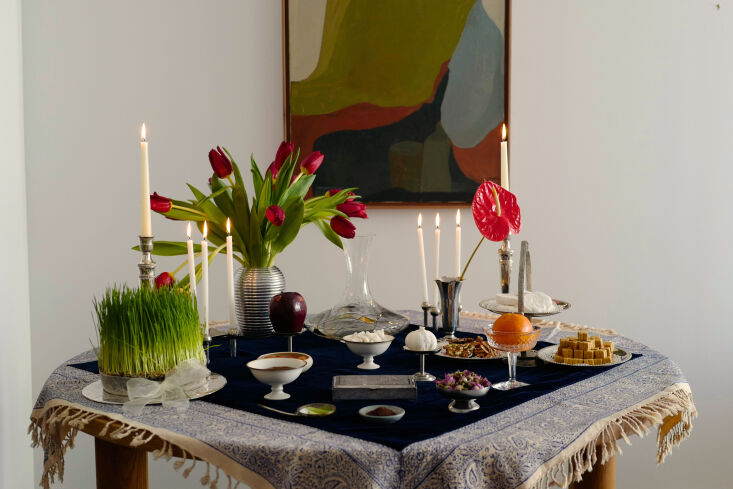
Here’s a look at how I designed my haft-sin this year.
Photography by Nicole Najafi.
Above: I would describe my haft-sin aesthetic as “modernist Marie Antoinette.” I love the old-world decadence of vintage silver and crystal but with some modernist restraint: one apple instead of a bowl of apples, a limited color palette, and an overall less-is-more approach.
The tablecloth is ghalamkar, an ancient Persian textile art from Isfahan, where my family is from. Artisans hand-carve designs into wooden blocks and then stamp them onto the fabric. I only take it out for special occasions, as my cats love to play with the tassels.
A short mention of Persian new year helps readers follow the flow.