Parsons school design. A brief context to set expectations.
Parsons school design: Quick notes
Dezeen School Shows: a data storage device crafted from mycelium that brings “cloud storage down to earth” is among the projects from Parsons School of Design at The New School.
Also featured is a series of cork products produced in collaboration with the Rockwell Group and public seating made from discarded wood.
Institution: Parsons School of Design at The New School
School: Parsons’ School of Constructed Environments
Course: Master of Architecture, Bachelor of Fine Arts in Architectural Design, Master of Architecture and Master of Fine Arts in Lighting Design Dual Degree, Bachelor of Fine Arts in Product Design, Master of Fine Arts in Industrial Design, Bachelor of Fine Arts in Interior Design, Master of Fine Arts in Interior Design, Master of Fine Arts in Interior Design and Lighting Design Double Major, Associate of Applied Science in Interior Design and Master of Fine Arts in Lighting Design
Tutors: Adegboyega Adefope, Mark Bechtel, Craig Bernecker, Andrew Bernheimer, Jacob Boatman, Carly Cannell, Yvette Chaparro, Rama Chorpash, Cotter Christian, Hyon Woo Scott Chung, Nadia Elrokhsy, Christine Facella, Mark Gardner, Paul Goldberger, Michele Gorman, Hee Chan Kim, Robert Kirkbride, Martina Kohler, David J. Lewis, Andrea Macruz, Allyson McDavid, Brian McGrath, Alison Mears, Daniel Michalik, Miodrag Mitrašinović, Eva Perez de Vega Steele, Derek Porter, Fiona Raby, Barent Roth, Jonsara Ruth, Kaveh Samiei, Glenn Shrum, Joel Stoehr, Sharon Egretta Sutton, Joel Towers, Michael Verbos, Alicia Tam Wei and Alfred Zollinger
School statement:
“Parsons’ School of Constructed Environments guides tomorrow’s leaders toward creating socially just, environmentally sustainable and technologically innovative buildings, interiors, lighting and products through curricula that facilitate uniquely rich collaborative work.
“We cultivate the skills, values, and vision that are vital to fostering a more integrated, equitable and delightful world.
“As a community, we explore regenerative material and design practices that break from convention.
“We cultivate a global outlook while drawing on the local resources of NYC and its groundbreakers.
“And as the only major design school embedded in a research university, Parsons gives students access to an array of disciplines that surround their field. Here – in fabrication shops, computing labs, NYC’s only light lab, the Angelo Donghia Healthier Materials Library and open design studios – students develop into responsible, engaged collaborators and innovators.
“Visit Parsons’ end-of-year show in NYC from 14 to 21 May 2026 at 25 East 13th Street and 39 West 13th Street.”
Infrastructure: A Confrontation by Gunnar Perkins
“My project reimagines a former industrial site near Brooklyn’s Gowanus Canal.
“The site lies at the intersection of the Brooklyn-Queens Expressway and the Smith – 9th Street Subway platform, which serves as the primary transit hub for the area.
“I redesigned several contaminated plots along the canal to form a new town square without erasing the traces of the industrial past of the site.
“An elevated walkway and bike route enable people to safely navigate the difficult conditions created by the large-scale infrastructure on the site.
“I adapted a former concrete plant into an open-air stage for public performances and transformed several buildings along 9th Street into workshops and maker spaces.”
Student: Gunnar Perkins
Course: Master of Architecture (MArch)
Tutor: Astrid Lipka
Email: perkg283[at]newschool.edu
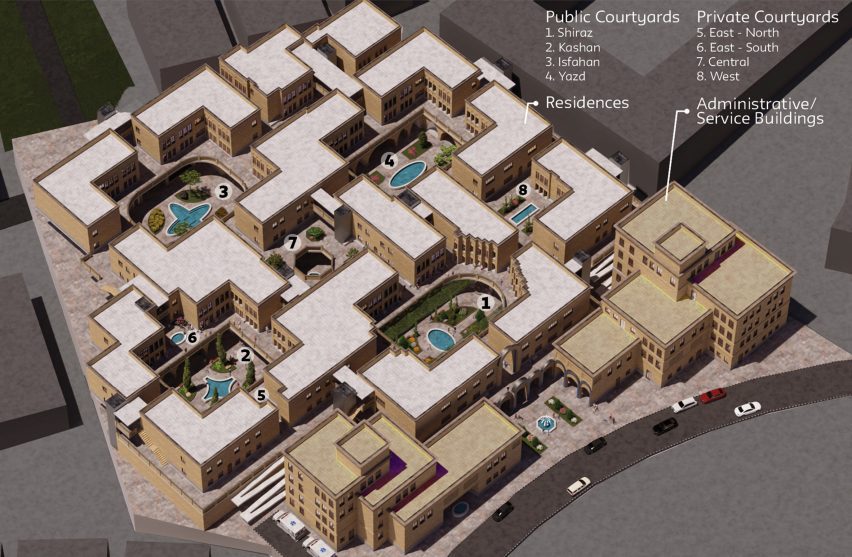
Belonging and Care: A Familiarity-Based Senior Housing Design in Iran by Mohammad Valizadeh Alvan
“Belonging and Care is senior housing in which familiar spatial elements foster the sense of belonging, comfort, agency and community that senior residences often lack.
“My project incorporates features from Iranian homes, including brickwork, central courtyards, openwork screens and the Se-Dari (a three-door bedroom that connects the indoors and outdoors).
“Residences house four people in private rooms with common areas. Wooden doors, glass insets, and curtains allow residents to control light, ventilation and privacy.
“Houses are arranged around courtyards that foster community; each has its own layout, material palette and regional references.
“The plan is integrated into a walkable neighbourhood with services that encourage intergenerational interaction.
“A multilevel space accommodates public gatherings at ground level and galleries above.”
Student: Mohammad Valizadeh Alvan
Course: Master of Architecture (MArch)/MFA Lighting Design
Tutors: Glenn Shrum, Katrina Matejcik and Jonah Rowen
Email: mohdi.valizadeh[at]gmail.com
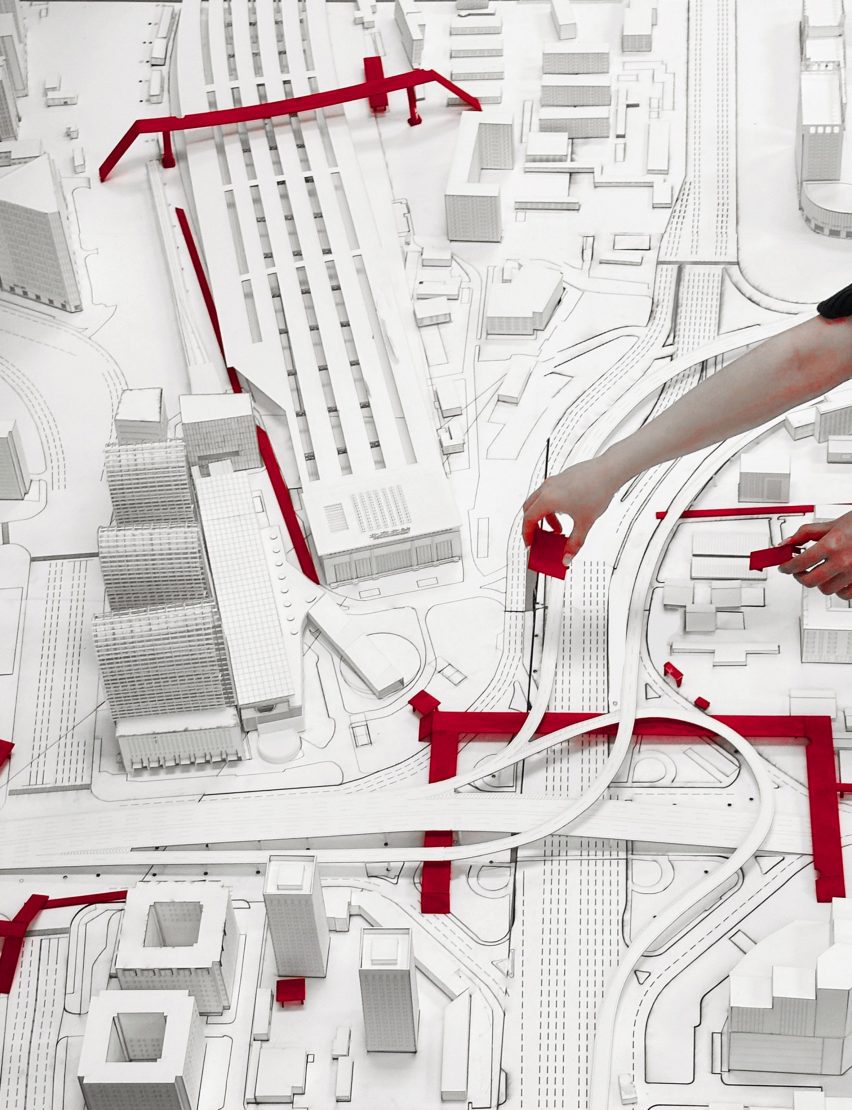
Reimagining Xizhimen: Block-Level Transformation Through Shared Spatial Systems by Yiki Dingmeng Liu and Eileen Yuntong Li
“Xizhimen is one of Beijing’s most infrastructurally layered yet socially fragmented districts.
“Dense commuter flows intersect with gated residential enclaves, creating sharp divides between movement and habitation.
“My project addresses two representative sites – Yufu Hutong and Beizhanbei Street – through a block-scale strategy of shared spatial systems.
“By reprogramming residual edges, repurposing disused structures, and layering Closed Cores, Transitional Thresholds and Open-Shared Zones, the design softens hard boundaries and transforms exclusion into interface – embedding wellness, reciprocity and coexistence into the urban fabric.”
Student: Yiki Dingmeng Liu and Eileen Yuntong Li
Course: BFA Architectural Design
Tutor: Miodrag Mitrašinović
Email: yiki_liu[at]gsd.harvard.edu and eileenyuntong[at]gmail.com
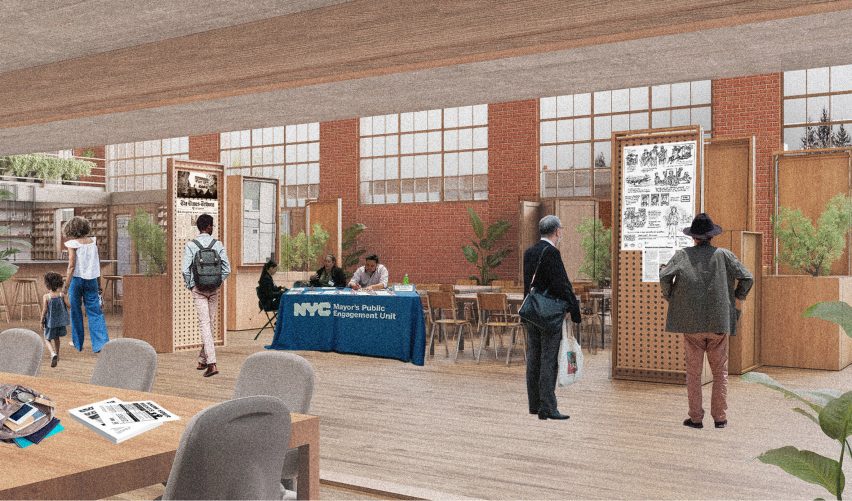
A Place for Us: Reclaiming Identity and Agency in Transitional Spaces by Khadeine Ali
“My thesis project is a product responding to the loss of control over our personal data on the cloud, which is run by unsustainable server farms.
“My regenerative memory storage device has a memory card and a heat sink encased in a shock-absorbent shell made from mycelium (fungi), hemp and polylactic acid, all sourced from linear waste streams.
“My product challenges the dominant aesthetics of consumer electronics while reintroducing materiality to digital memory, bringing cloud storage down to earth and building decentralised local networks for sustainable data sharing and storage.”
Student: Khadeine Ali
Course: MFA Industrial Design
Tutor: Rama Chorpash
Email: sreekrishnapillarisetty[at]gmail.com
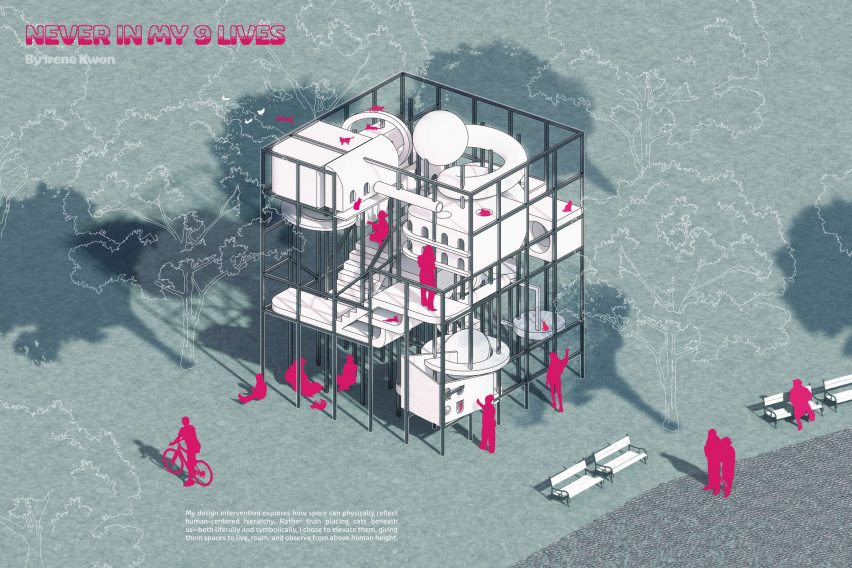
Never in My Nine Lives by Irene Kwon
“In my project, I explore the failure of human-centred design to provide accommodations for NYC’s growing stray cat population.
“I aimed to create a space that meets feral cats’ needs, giving them the freedom to explore, climb, observe, hide, rest and engage with people on their own terms.
“My research attempts to imagine the world from the standpoint of a ten-inch-high creature capable of jumping six times its own height.
“My project forced me to reconsider designing for shared space and extending my empathy beyond humans in ways that recognise the interconnectedness of all beings – including wildlife.”
Student: Irene Kwon
Course: BFA Interior Design
Tutors: Virginia Black and Camila Morales
Email: iriny0210[at]gmail.com
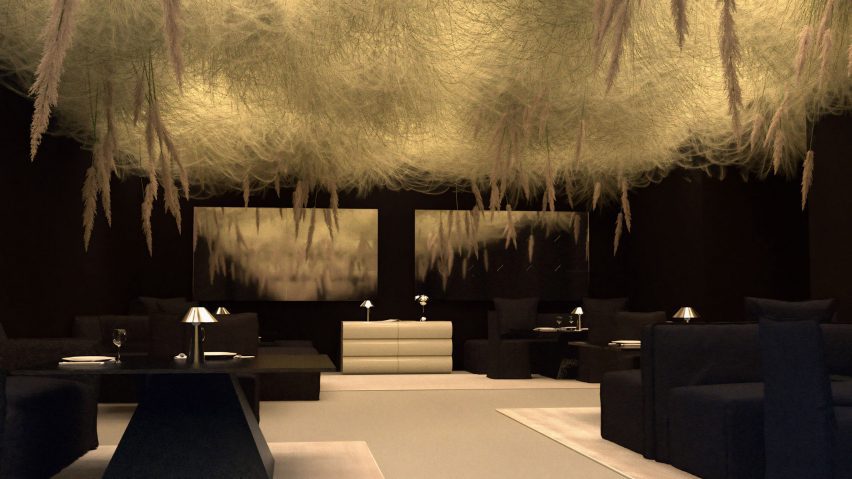
Nox by Gabrielle Ter-sarkissian
“For Nox, my final project, I chose to reimagine NYC’s iconic Chelsea Hotel as a wellness hotel and retreat space.
“I transformed the hotel into a darkness retreat, using a design scheme meant to reflect the inner journey to personal wellbeing.
“My goal was to create spaces that facilitate reflection and are free of visually distracting features.
“The hotel amenities are designed to enhance the retreat experience. Guests can dine in the restaurant and spend time in the meditation cave – a dark, tranquil space where they can meditate on warm sand in a ritual introducing them to the retreat.
“A tea garden sharing the warm sand floor of the meditation cave offers another soothing environment.”
Student: Gabrielle Ter-sarkissian
Course: AAS Interior Design
Tutor: Gersende Chevalier
Email: gybtrss[at]yahoo.com
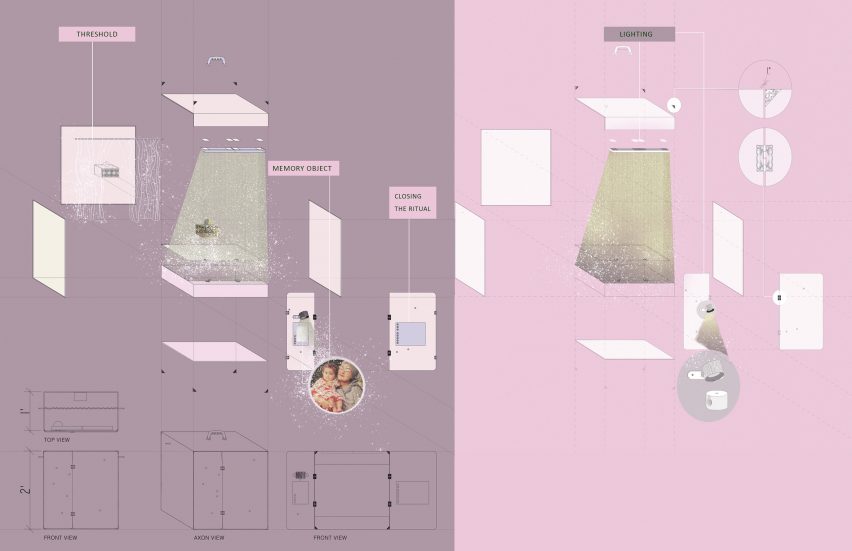
Pinky: Healing Rituals in Cancer Care by Zoha Tasneem
“My thesis employs microspatial design to reimagine cancer care routines as rituals aimed at assisting patients during challenging periods.
“Anchoring my project is a box that travels with the patient, its form evoking familiar objects like vanity cases or briefcases that invite deliberate handling.
“Opening it involves a kind of ritual – releasing latches, lifting compartments and engaging with materials that acquire a patina.
“Patients document moments of strength using fabric and magnetised objects placed in the box; colour and scent record shifting emotional states. The box’s 2,700K to 3,000K lighting was inspired by candlelight.
“The light level is low when the box is closed but slowly intensifies as it is opened, representing a pathway to intentionality. Each use is notated, creating an archive of resilience.”
Student: Zoha Tasneem
Course: MFA Interior Design/Lighting Design Double Major
Tutors: Glenn Schrum, Katrina Matejcik and Jonah Rowen
Email: zoha.tasneem[at]gmail.com
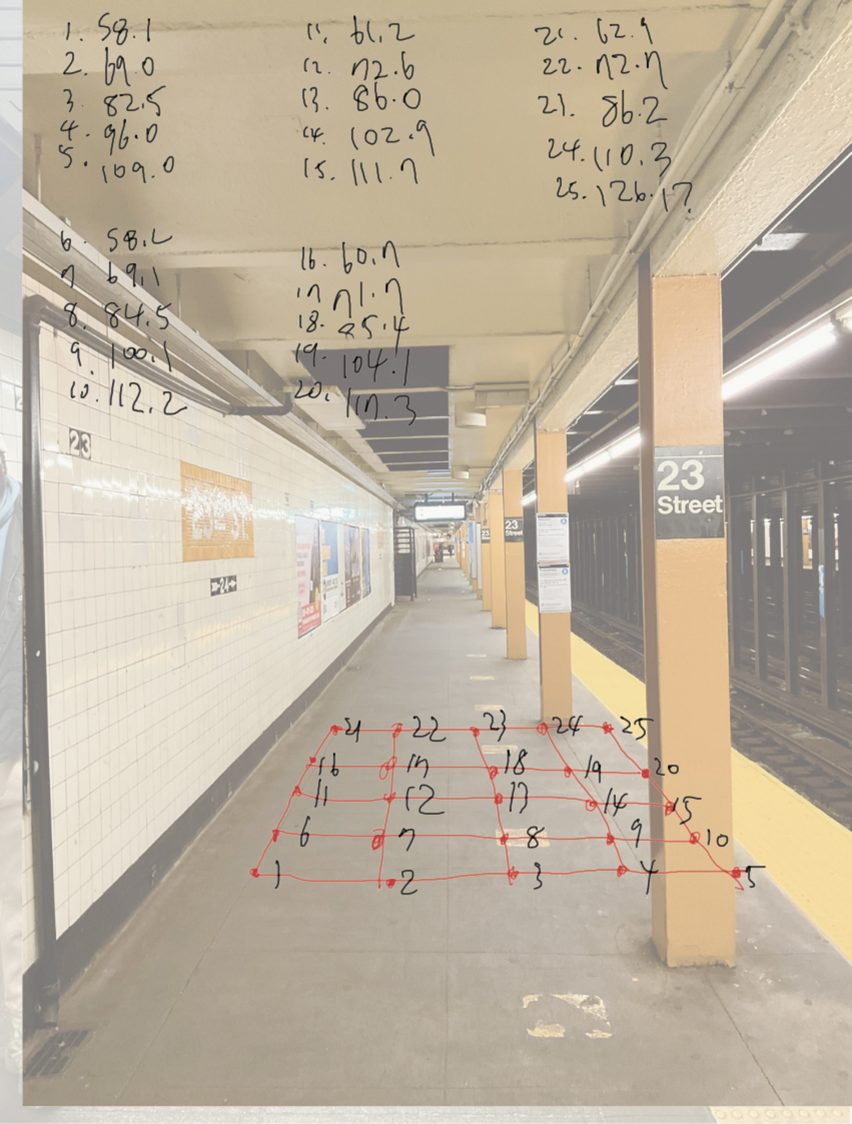
More Isn’t Always Enough: Challenging the Perception of Safety on NYC Subway Platforms by Hyesoo Chun
“When the NYC MTA’s re-new-vation programme replaced subway station fluorescents with bright LEDs – on the belief that more light creates safety – I wondered if rider experience would improve.
“I measured illuminance in stations, pairing data with on-site rider surveys about perceived brightness and safety.
“I then digitally rendered lighting scenarios using AGI32, a lighting simulation software.
“Participants evaluated these scenarios and in both, luminance balance (the way bright surfaces in one’s field of vision appear relative to one another) mattered far more than overall light levels.
“A moderate 2:1 wall-to-floor luminance ratio consistently produced feelings of safety even when the overall output was lower, suggesting that brighter isn’t always better—but better lighting design can make people feel safer.”
Student: Hyesoo Chun
Course: MFA Lighting Design
Tutors: Craig Bernecker, Francesca Bastianini and Kyle McGahan
Email: ooseyh[at]gmail.com
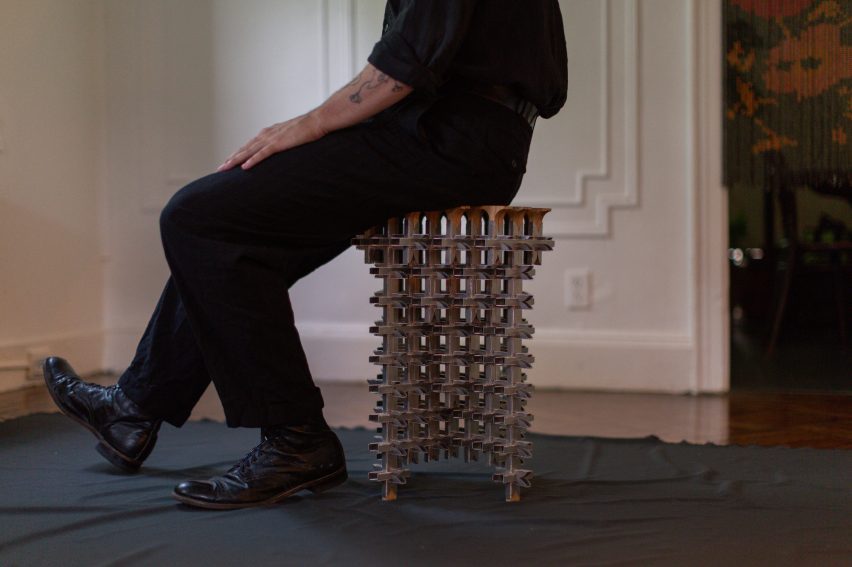
Crown of Thorns by Benjamin Graham
“Crown of Thorns is a traditional glue-free wooden joinery method in which hand-notched sticks are woven into intricate lattices.
“Originating in Northern Europe, the technique was used for decorative objects before disappearing almost completely.
“A Colorado craftsperson who learned the method from his grandfather taught it to me.
“After days of working under him, I came to understand the geometry enabling these forms to hold together through tension alone.
“I then applied the technique to contemporary products: a stool made from 465 hand-bent aluminium pieces – the first known piece of Crown of Thorns furniture – and a coffee table with an aluminium lattice acting as an exoskeleton for wood.
“A folk design refined over generations, Crown of Thorns can inspire designers to explore new processes.”
Student: Benjamin Graham
Course: BFA Product Design
Tutors: Ari Elefterin
Email: benclaygraham[at]gmail.com
Rockwell Group and Corticeira Amorim X Parsons collaborative project for Cork Collective/Salone di Mobile 2025
“Parsons’ School of Constructed Environments recently partnered with the NYC design firm Rockwell Group and Portugal’s largest cork producer, Corticeira Amorim.
“The industry leaders challenged undergraduate students to develop cork products to raise public awareness of the regenerative material’s capacities at Milan Design Week, the world’s foremost product design showcase.
“Students experimented with a range of making techniques, molding and carving the endlessly recyclable, antimicrobial, naturally insulating, water – and fire resistant material into flatpack furniture, tabletop objects, building tiles and other products.
“They traveled to Amorim’s forests and factories in Portugal, learning about cork’s many applications and role in sustainable design from agricultural, materials engineering and business specialists there.
“After rounds of critique from David Rockwell, MillerKnoll’s head of Product Design, and other design business and editorial leaders, students finalised their prototypes and headed to Milan for Salone di Mobile, where their work was displayed.
“Students also gave cork-working demonstrations to fairgoers while expanding their professional networks.”
Students: Rockwell Group and Corticeira Amorim X Parsons
Course: Cork in the Constructed Environment
Tutor: Daniel Michalik
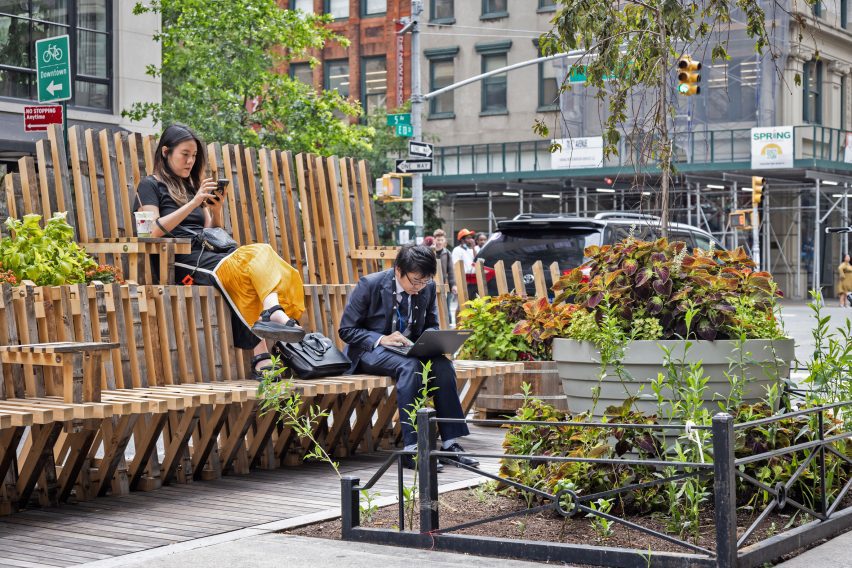
NYC Department of Transportation X Parsons Partnership on Street Seats
“For more than a decade, Parsons has partnered with the NYC Department of Transportation on an annual project to create campus-area public seating made with sustainability – promoting materials and techniques.
“In a spring design-build class, undergraduate students explore design concepts and then construct a chosen design in May, giving campus passersby a place to relax and gather.
“Past iterations have employed bamboo, cast-off plywood and other repurposed and environmentally responsible materials.
“This past year, Parsons collaborated with Tri-Lox, a local firm that recovers discarded wood from city buildings.
“A landscaping nonprofit donated shrubs and flowers, which became part of the installation.
“The class’ seating is later donated to a local organisation and incorporated into its facilities, allowing the project to be reused – and offering students the rare opportunity to see their design ideas come to life in NYC.”
Students: NYC Department of Transportation X Parsons
Course: Design Build: Urban Public Space
Tutors: Maya McGlynn and Ross Myren
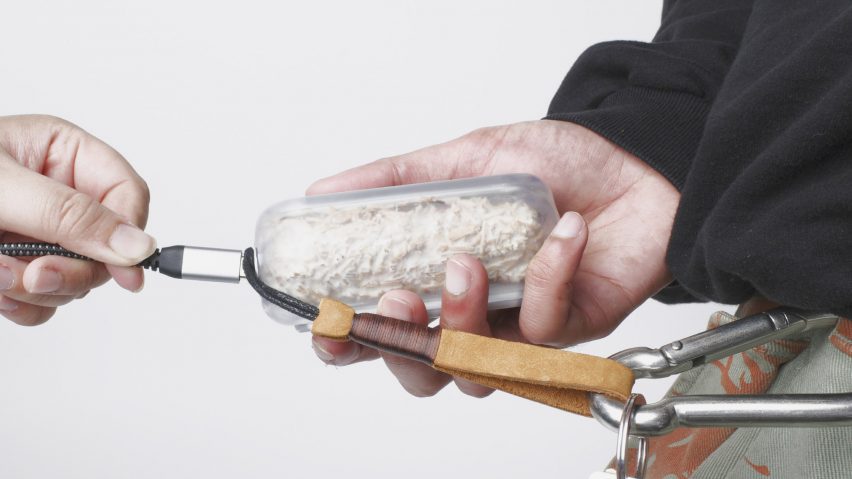
Soft-Drive by Sree Krishna Pillarisetti
“My thesis project is a product responding to the loss of control over our personal data on the cloud, which is run by unsustainable server farms.
“My regenerative memory storage device has a memory card and a heat sink encased in a shock-absorbent shell made from mycelium (fungi), hemp and polylactic acid, all sourced from linear waste streams.
“My product challenges the dominant aesthetics of consumer electronics while reintroducing materiality to digital memory, bringing cloud storage down to earth and building decentralised local networks for sustainable data sharing and storage.”
Student: Sree Krishna Pillarisetti
Course: MFA Industrial Design
Tutor: Rama Chorpash
Email: sreekrishnapillarisetty[at]gmail.com
Partnership content
This school show is a partnership between Dezeen and Parsons School of Design at The New School. Find out more about Dezeen partnership content here.
We reference Parsons school design briefly to keep the thread coherent.
A short mention of Parsons school design helps readers follow the flow.