
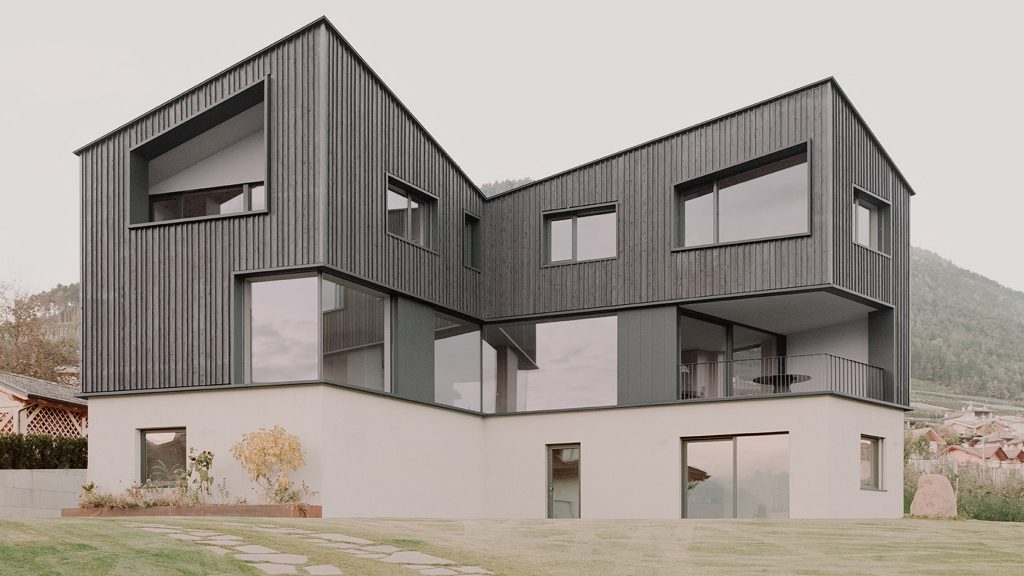
Italian studio MoDus Architect has completed Hometown House, a dwelling in Trento that contrasts a black-timber exterior with light and airy larch-lined interiors.
Set among the rolling hills and orchards of the Non Valley, Hometown House was designed by MoDus Architects for a client returning to his hometown after decades abroad.
It occupies the site where the client’s parents’ home once stood and next to which his brother still lives.
MoDus Architects has completed a black-timber dwelling in Trento
Looking to mirror the character of the rural site, Hometown House sits on a base of local porphyry stone, with its upper levels finished with black-stained larch cladding and paler larch interiors.
“From the outset, the client expressed a clear preference for larch wood and local porphyry, not as decorative elements but as primary architectural matter,” MoDus Architects told Dezeen.
“Their juxtaposition – wood and stone, grain and mass, warmth and resistance – articulates a dialogue between refinement and ruggedness that mirrors the dual character of the site itself.”
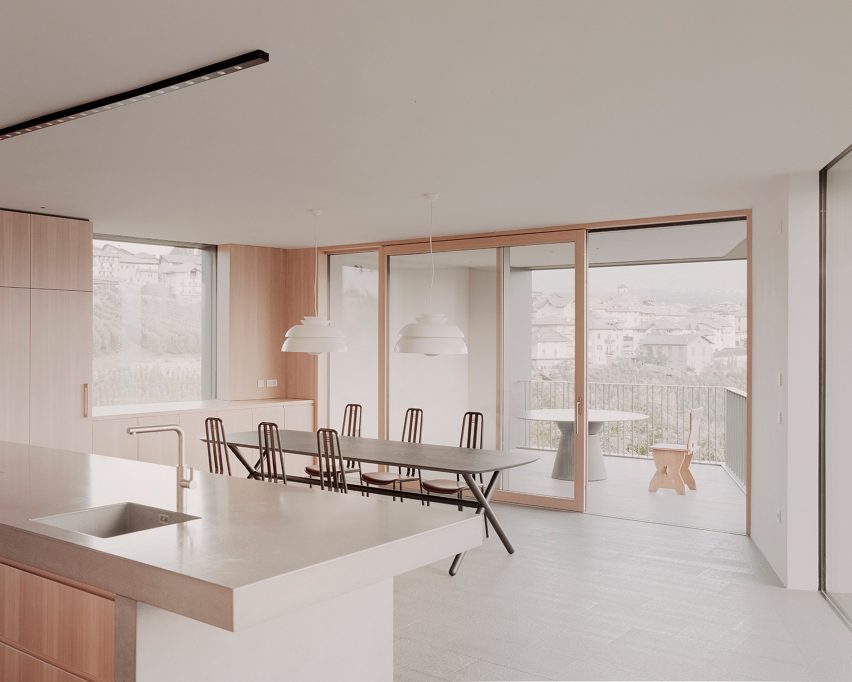 Larch lines the home’s interior
According to MoDus Architects, it was important for the home to cater for both larger family gatherings as well as the daily lives of two residents, which informed a V-shaped floor plan with two wings on either side of an entrance hall.
On the ground floor, this separates a large, slightly sunken living space to the east from the kitchen and dining area to the south, which opens onto an external patio.
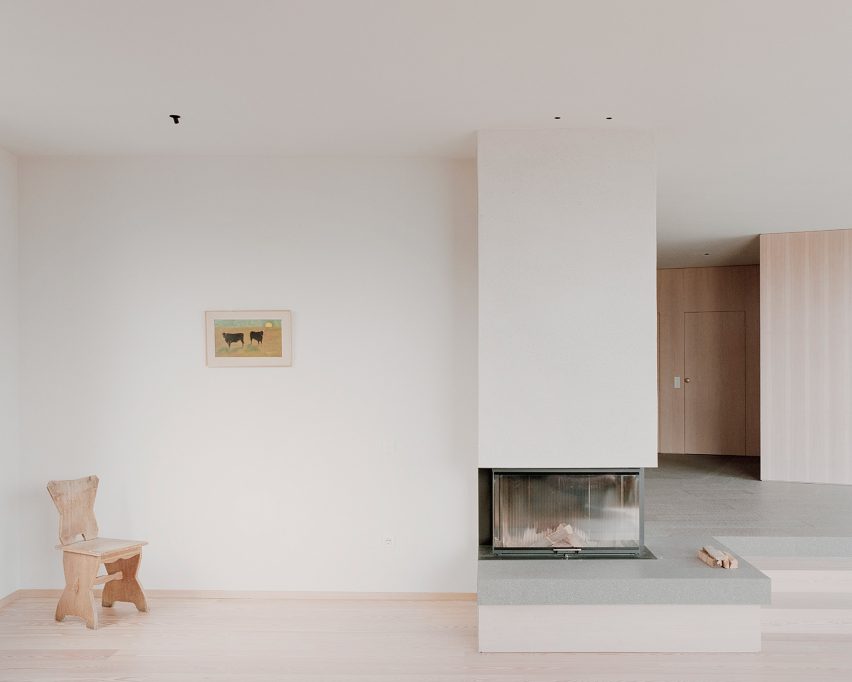 A sunken living space is contained on the ground floor
The inner walls of the V-shaped plan overlook the landscape through full-height windows, while on the outer edges, smaller windows frame views of the surrounding residential buildings.
Above is a total of four bedrooms, three of which are ensuite, organised around a central study beneath sloping timber-clad ceilings punctured by square skylights.
“This bifurcation produces two differentiated spatial sequences and modes of inhabitation, articulating the site’s dual orientation and positioning the house as an active mediator between its immediate residential fabric and the larger landscape,” the studio explained.
Charred timber and exposed concrete defines conjoined houses in Germany by Buero Wagner
Within Hometown House’s partially sunken stone base is an independent apartment, alongside a garage, a laundry, an exposed concrete wine cellar and a stube – a traditional wood-panelled living area found in Alpine homes.
This stone plinth extends upwards to frame the main entrance to the home with chamfered edges, where a timber door is finished with an angular push plate that resembles the home’s floor plan – a recurring motif throughout MoDus Architects’ residential projects.
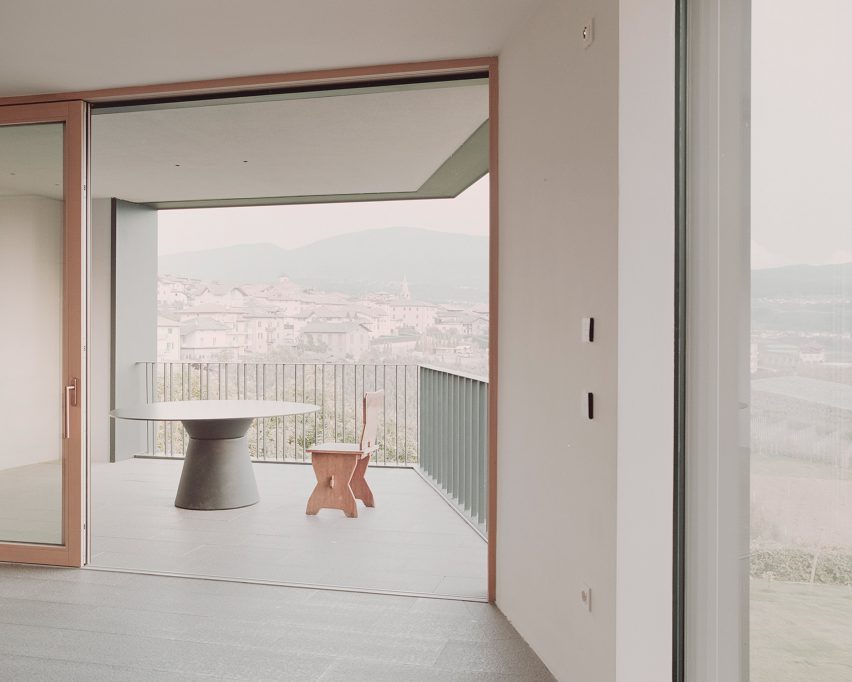 A sheltered patio overlooks the surrounding landscape
Based in the northern Italian town of Brixen, MoDus Architects was founded in 2000 by Sandy Attia and Matteo Scagnol.
Previous projects by the studio include a kindergarten in the South Tyrolean town of Terlano, which features a green plastered facade finished with a tartan pattern, and a sports centre in Laghetti with a tapering tower.
The photography is by Simone Bossi.













Quick thought — This feels very authentic — great post.
Also – Well said — couldn’t agree more. Thanks for this!