
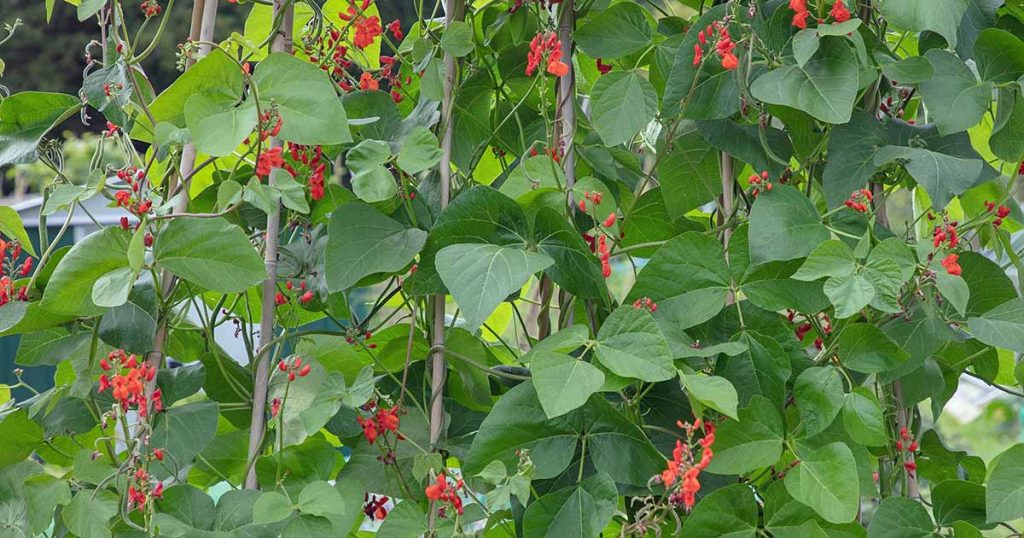
4. Bacterial Brown Spot
Manage common bean: a concise orientation before we get practical.
Manage common bean: Quick notes
Bacterial brown spot, caused by Pseudomonas syringae pv. syringae, thrives in warm, wet weather between 80 and 85°F.
The bacteria survive in crop residue, weeds, and contaminated seed, spreading via splashing rain and wind.
Infected beans develop small, circular brown lesions surrounded by yellow tissue. The centers often fall out, creating a shot-hole appearance.
Pods develop water-soaked spots that turn brown and sunken, sometimes causing the pod to twist or bend.
Use certified disease-free seed and rotate beans with non-legumes for two to three years. Bury crop debris after harvest and control nearby weeds.
For infected crops, you can salvage your yields by using copper-based bactericides 40 days after the plants emerge, then additional applications every seven to 10 days.
5. Bean Rust
Bean rust, caused by the fungus Uromyces appendiculatus, produces raised, reddish-brown pustules surrounded by yellow halos on leaves and pods.
The pustules contain powdery spores that give infected bean foliage a rusty appearance. Severe infections cause leaves to die and drop, significantly reducing yields.
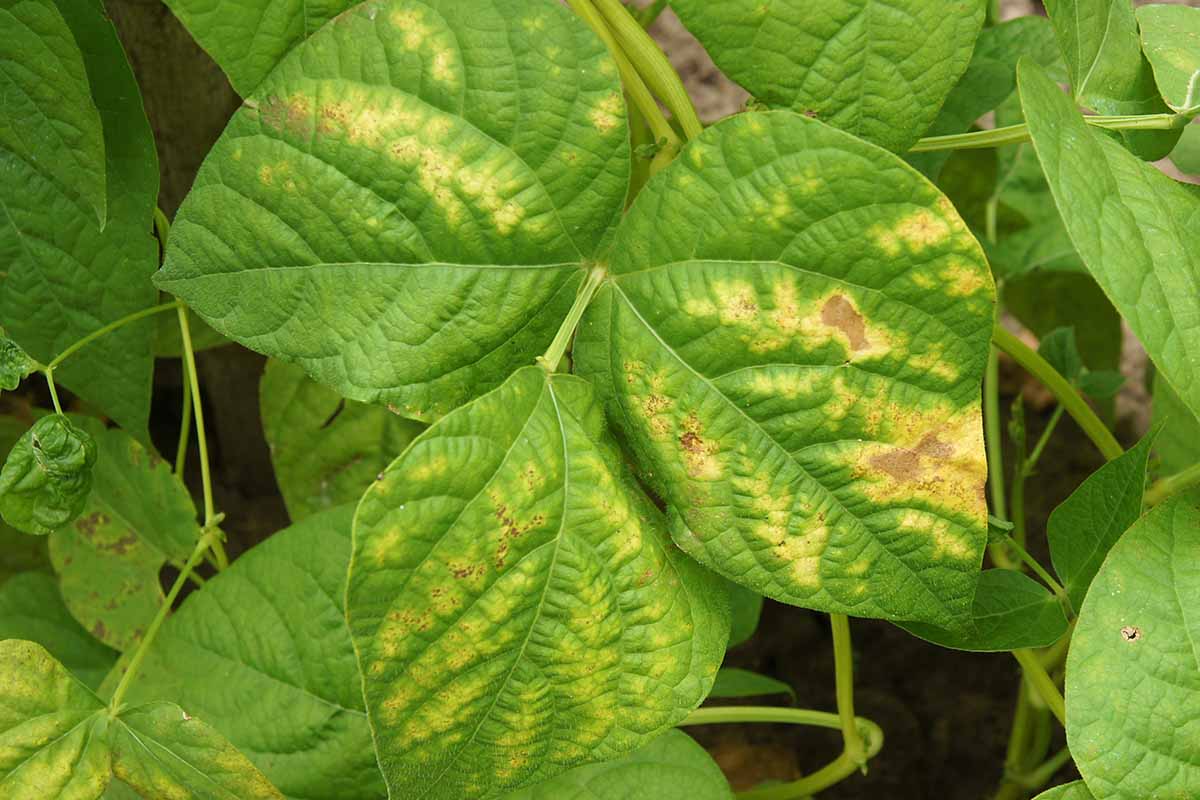
The fungus overwinters in plant debris and spreads by wind. It thrives in moderate temperatures between 68 and 77°F with high humidity or moisture.
Rotate beans with non-leguminous crops and remove debris immediately after harvest.
Remove volunteers and avoid overhead watering that keeps leaves wet for extended periods. Grow resistant varieties when available.
For severe infections, apply fungicides before the disease spreads throughout the garden.
6. Black Root Rot
Caused by the fungus Thielaviopsis basicola (syn. Berkeleyomyces spp.), black root rot affects a wide variety of flora. The pathogen produces spores that persist in soil for several years.
Spores germinate in wet conditions at temperatures between 55 and 70°F, particularly when the soil pH is neutral to alkaline.
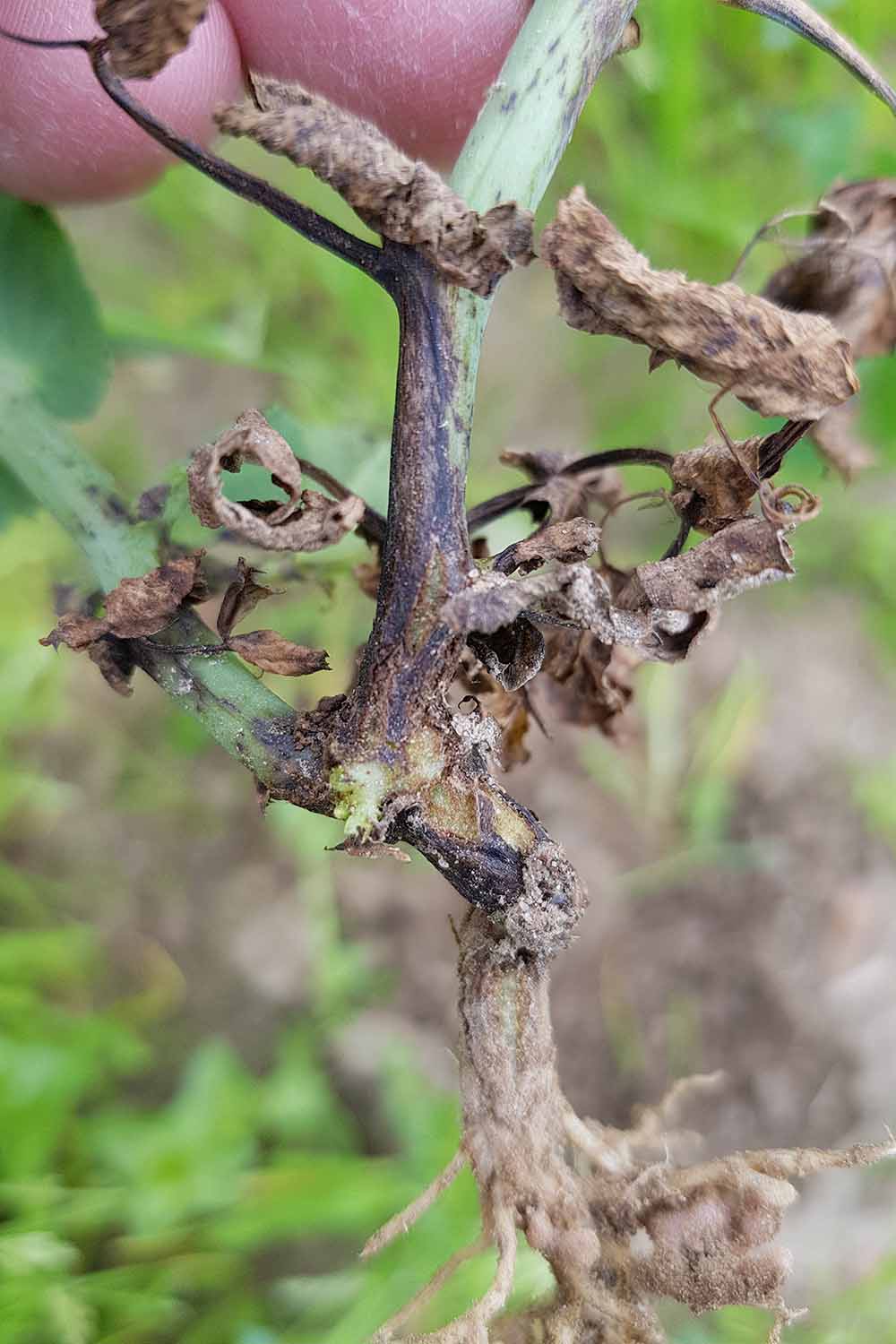
Roots develop elongated red lesions that turn black as spores form.
Entire roots can turn black, and infected bean plants become chlorotic, stunted, and wilted. Leaves may drop and may collapse.
Black root rot is tough to control, so prevention is much more effective than management.
Fungicides can be used at the first sign of disease, and insect vectors such as fungus gnats and shore flies should be controlled.
If any crops become diseased, they should be removed and destroyed.
7. Bean Mosaic Virus
Bean common mosaic virus (BCMV) and bean common mosaic necrosis virus (BCMNV) spread through infected seed and aphid vectors. BCMV is more common than BCMNV.
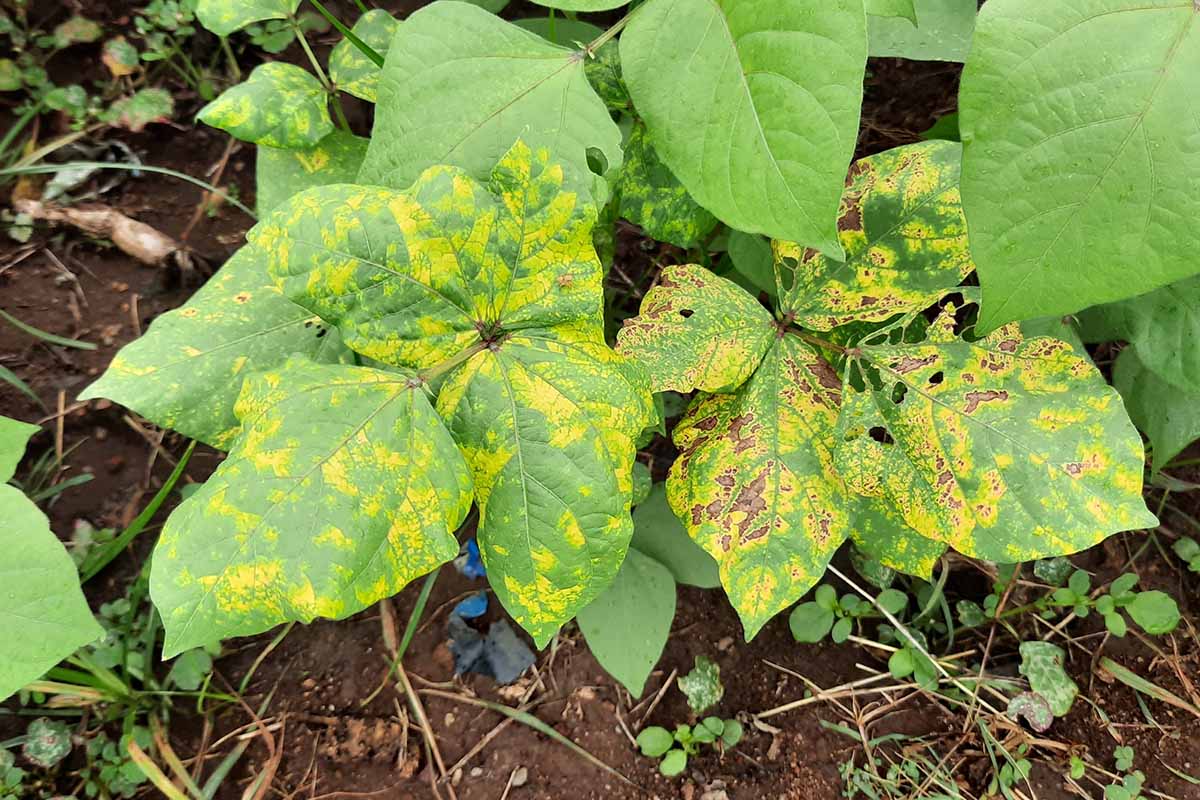
BCMV causes stunted growth, reduced yields, and distorted leaves with mosaic patterns of light green, dark green, and yellow patches.
Plants with the dominant I resistance gene are protected from BCMV but become hypersensitive to BCMNV.
When these resistant varieties encounter BCMNV, they develop small reddish-brown spots on shoots, followed by tissue death that spreads through leaves and stems, eventually killing the entire plant.
Plants without the I gene infected with BCMV simply develop standard mosaic symptoms.
Use certified, disease-free seed and grow resistant varieties. Control aphids to reduce virus spread. Remove and destroy infected plants immediately.
8. Damping Off
Caused by pathogens such as Pythium, Rhizoctonia, and Thielaviopsis, damping off is a disease that severely weakens seedlings.
They develop water-soaked lesions, rot, and collapse. The soil-borne pathogens are primarily an active threat in cool, wet weather.
We reference Manage common bean briefly to keep the thread coherent.














Small note · This tip on “How to Identify and Manage 11 Common Bea” is so useful — thanks for sharing. Will try it.
On a similar note • I appreciate the point about “How to Identify and Manage 11 Common Bea” — very helpful. Thanks for this!
On a similar note • I appreciate the point about “How to Identify and Manage 11 Common Bea” — very helpful. Thanks for this!
On a similar note • I appreciate the point about “How to Identify and Manage 11 Common Bea” — very helpful. Thanks for this!
On a similar note • I appreciate the point about “How to Identify and Manage 11 Common Bea” — very helpful. Thanks for this!
On a similar note • I appreciate the point about “How to Identify and Manage 11 Common Bea” — very helpful. Thanks for this!
On a similar note • I appreciate the point about “How to Identify and Manage 11 Common Bea” — very helpful. Thanks for this!
PS: Nice take on “How to Identify and Manage 11 Common Bea” — I’ll try that soon. Great share.
Heads up — I appreciate the point about “How to Identify and Manage 11 Common Bea” — very helpful. Great share.
FYI – So true — this connects with me. So cozy.
FYI – So true — this connects with me. So cozy.
FYI: This feels very homey and real — love it. Great share.
Tiny tip – Such a warm note about “How to Identify and Manage 11 Common Bea” — lovely. So cozy.
Tiny tip – Such a warm note about “How to Identify and Manage 11 Common Bea” — lovely. So cozy.
Tiny tip – Such a warm note about “How to Identify and Manage 11 Common Bea” — lovely. So cozy.
Tiny tip – Such a warm note about “How to Identify and Manage 11 Common Bea” — lovely. So cozy.
Tiny tip – Such a warm note about “How to Identify and Manage 11 Common Bea” — lovely. So cozy.
Tiny tip – Such a warm note about “How to Identify and Manage 11 Common Bea” — lovely. So cozy.
Tiny tip – Such a warm note about “How to Identify and Manage 11 Common Bea” — lovely. So cozy.