
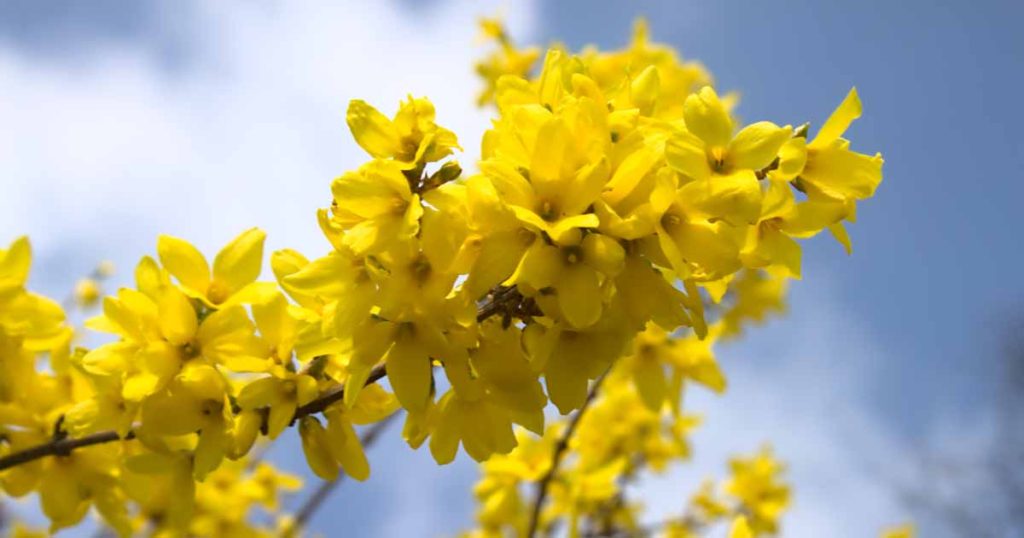
How grow and — a quick note to anchor this piece for readers.
How grow and: Quick notes
Smaller types play well in mixed perennial and bulb beds and borders, where they add bold color in spring and punctuate summer plantings with their attractive, lance-like, serrated green leaves.
Create mixed shrub plantings with early rhododendron, flowering quince, and pussy willow, for a pretty place to take spring holiday photos with the family.
A versatile shrub that grows fast is a gardener’s best friend, when it comes to blocking an undesirable view or creating a privacy screen for the enjoyment of outdoor space.
How to Grow
There are two good times to plant forsythia – after it blooms, and just prior to winter dormancy.
First of all, you need to find a location for your new shrub.
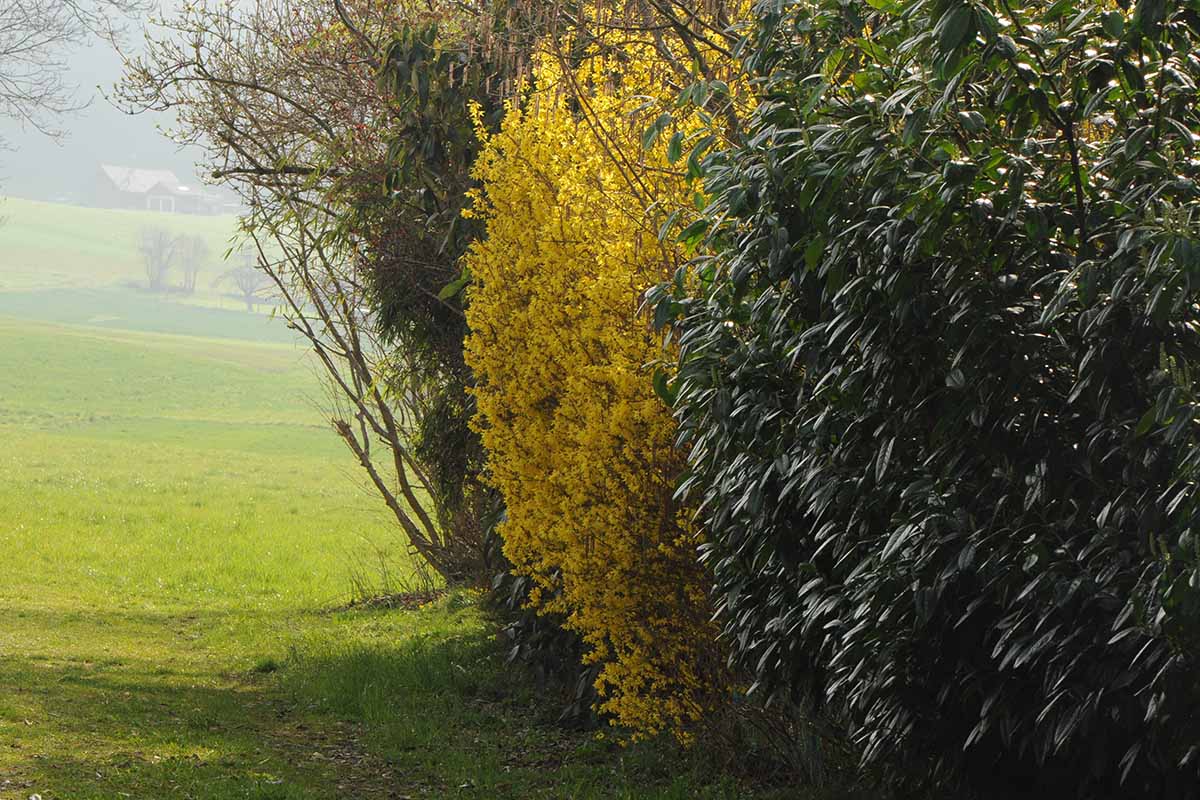
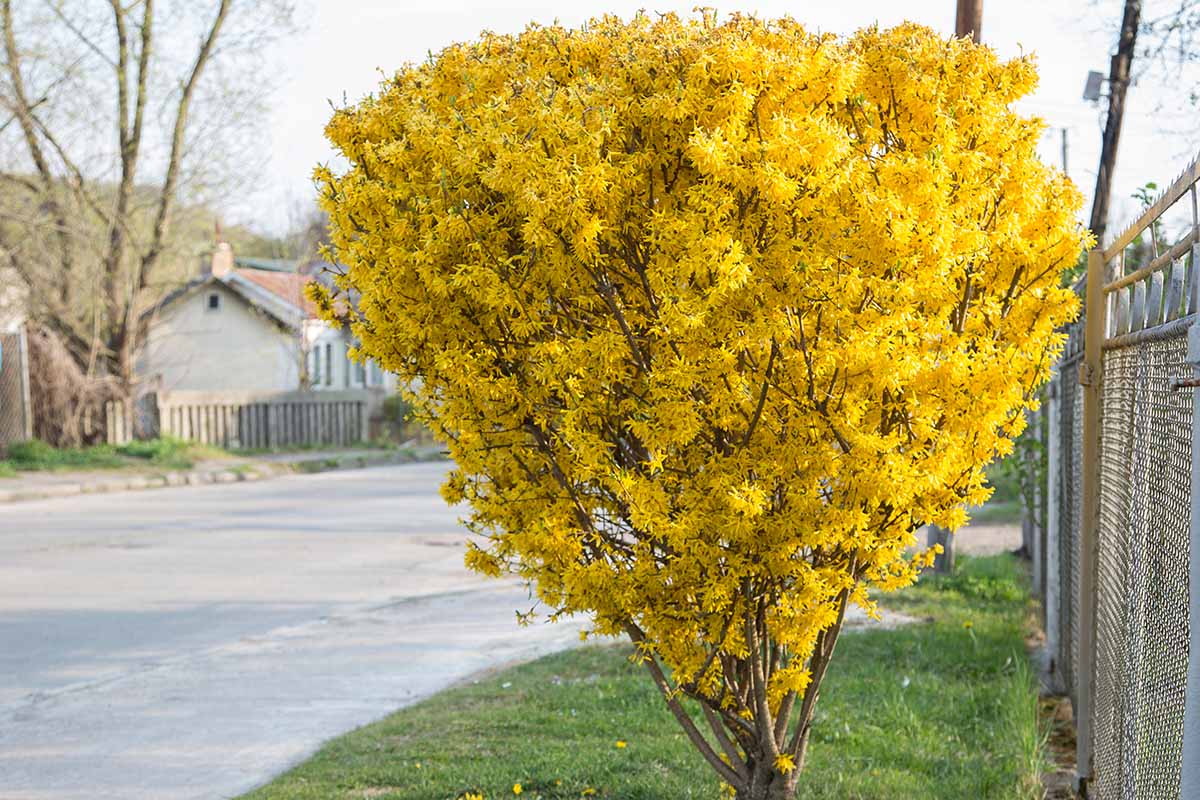
Some dwarf selections are two feet tall and wide, while some full-size varieties top out at eight to 10 feet tall and 10 to 12 feet wide.
Be sure to take mature dimensions into account when deciding on a location.
Light
Choose a site with full sun. It is possible to grow forsythia in part shade, but you may have fewer blossoms.
Soil
Organically-rich soil is best, but even clay is okay, provided it drains well.
To improve drainage, incorporate leaf mulch or sand to loosen it up. The ideal pH may vary from a slightly acidic 6.5 to a slightly alkaline 7.5.
If you want to know your soil’s characteristics with certainty, you may contact the local extension of a land grant university about conducting a soil test.
Water
In the absence of a soaking rain, water each week during the growing season.
Too much or too little water may cause yellowing of the leaves.
In addition, in the first year of life, new shrubs benefit from a deep watering or two during winter dormancy if the weather is especially dry. Choose a day when the ground is not frozen.
Fertilizing
You can fertilize once just before bloom time with a well-balanced, all-purpose, slow-release fertilizer, per package instructions.
Cultivars to Select
There are 11 different species of forsythia. There was a time in the early 20th century when the upright, green stem variety F. viridissima was the reigning queen in American gardens.
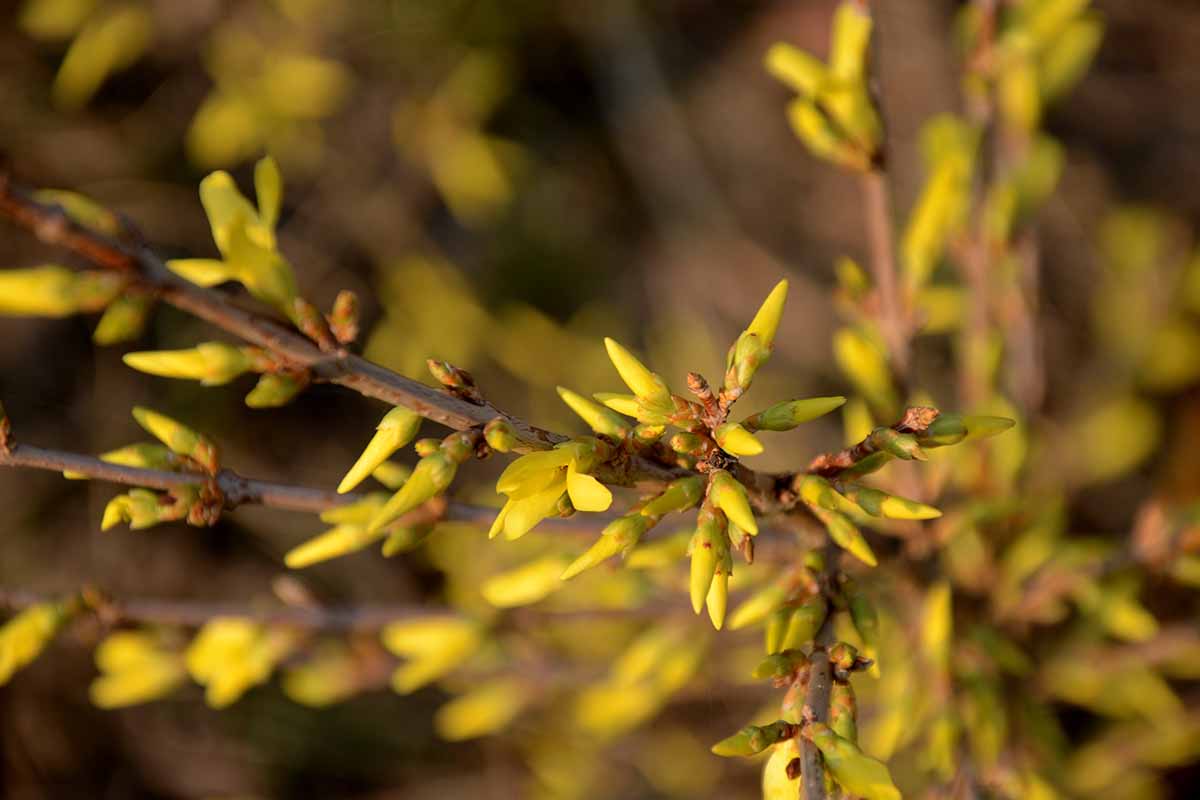
Today, Forsythia x intermedia cultivars take center stage, with a host of options from which to choose.
Here are a few to whet your appetite for this bright yellow harbinger of spring!
Bronxensis
Straight from the New York Botanical Garden of 1940, F. viridissima ‘Bronxensis’ is a dwarf variety that tops out at a petite two to three feet tall.
Ideal for mass planting as a ground cover, a friendly low-profile hedge, or mixed border companion, this petite shrub offers the beauty of large varieties in a manageable package.
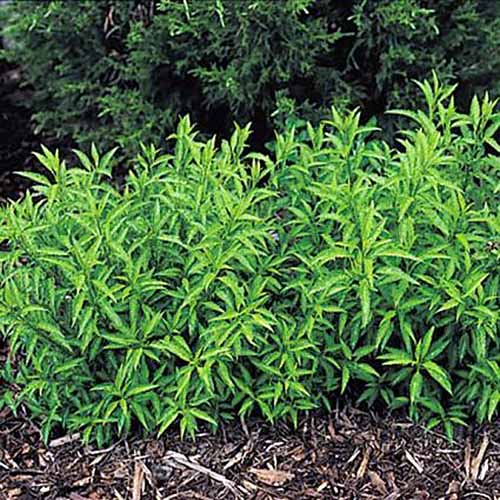
‘Bronxensis’
Its bright yellow blossoms appear a little later in spring than most, and the leaves are lush green in summer and bronze in autumn.
Find this cultivar available from Nature Hills Nursery.
Gold Tide Courtasol
This compact Forsythia x intermedia cultivar reaches a mature height of two to three feet, with a spread of four feet.
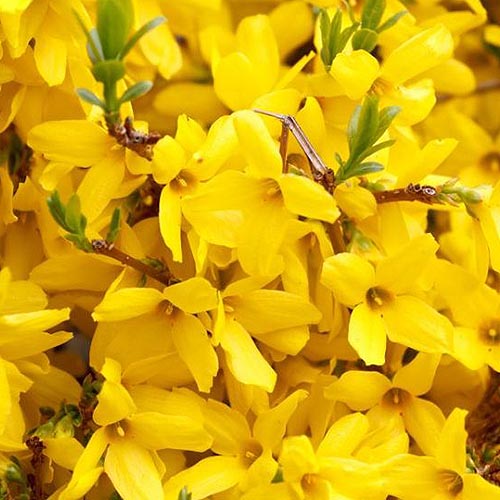
Gold Tide® ‘Courtasol’
Well suited to foundation and border plantings, its lemon-yellow blossoms bid a cheerful welcome beside walkways and accented by bulb flowers.
You can find Gold Tide® plants available from Nature Hills Nursery.
Lynwood Gold
Generous clusters of bold yellow blooms line the upright branches of this six- to eight-foot-tall Forsythia x intermedia cultivar.
With spreads of eight to 10 feet, it makes an imposing privacy screen or specimen planting.
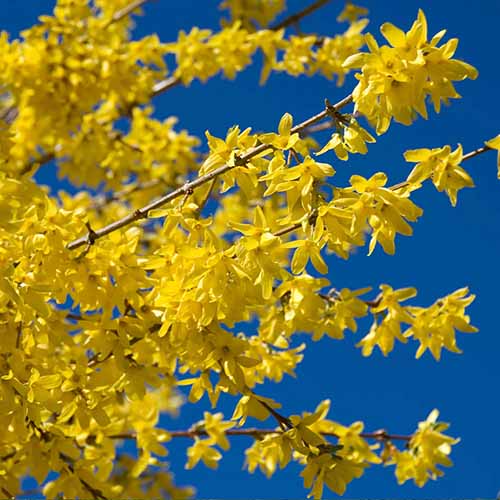
‘Lynwood Gold’
The foliage provides a cool backdrop of green in the summer months, before bronzing in the fall.
You can find plants in one-, two-, and three-gallon containers available at Fast Growing Trees.
Maintenance
As mentioned, different forsythia varieties are available in sizes ranging from 12 inches to 10 feet.
You have two options with this fast-growing shrub:
- Let it grow naturally, unimpeded and untrimmed.
- Prune it to a certain height and width, to fit neatly into a desired space, like a hedge.
The best time to prune is immediately after flowering. This is because flower buds begin to form soon after the blossoms drop, and by summer’s end, they are in place for next year.
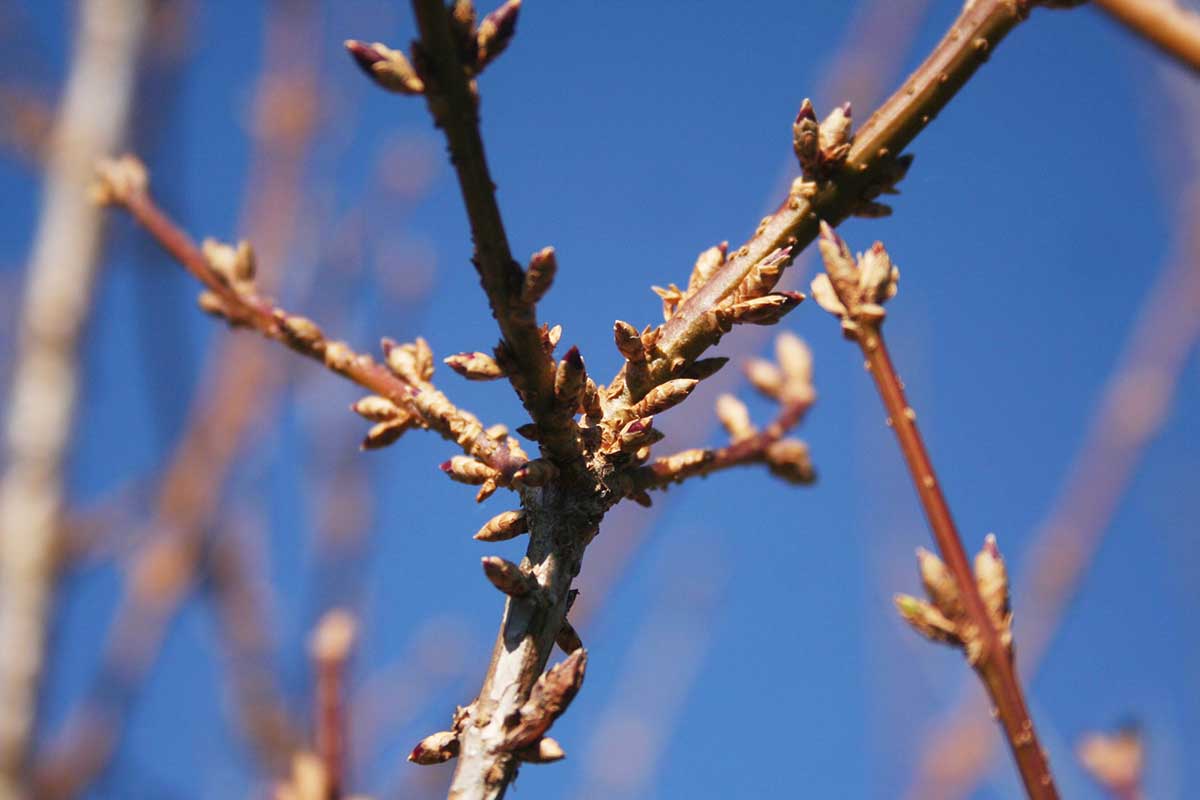
If you were to prune at any other time, you’d cut them off and have few to no flowers the following spring.
Even if you choose a natural style, you should still prune occasionally. Remove dead or damaged stems to improve appearance and maintain good plant health.
Restore youthful vigor to older bushes by randomly cutting one-third of the old wood stems to the ground every three years or so.
Hedges are a bit trickier.
Prune deeply after flowering to maintain the desired shape. Pruning periodically throughout the growing season is not an option.
Pruning too late or too often is likely to cause poor flowering next bloom time.
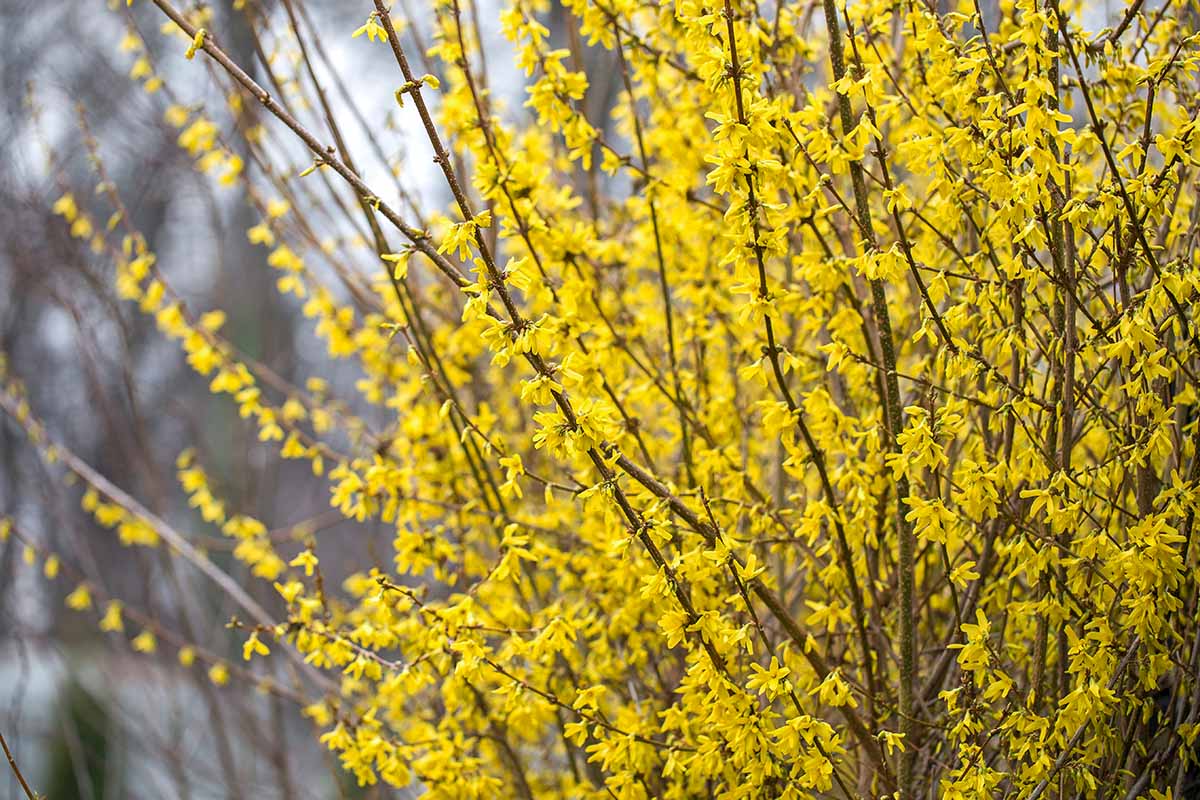
As for cutting techniques, pruning to the ground encourages the growth of long, airy canes, and is well-suited to a rounded mound with arching branches.
A short mention of How grow and helps readers follow the flow.
How grow and comes up here to connect ideas for clarity.













FYI — This brightened my feed — delightful share. Saving it.
Quick thought • Loved this about “How to Grow and Care for Forsythia Shrub” — such a nice idea.