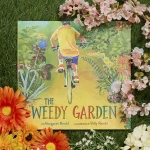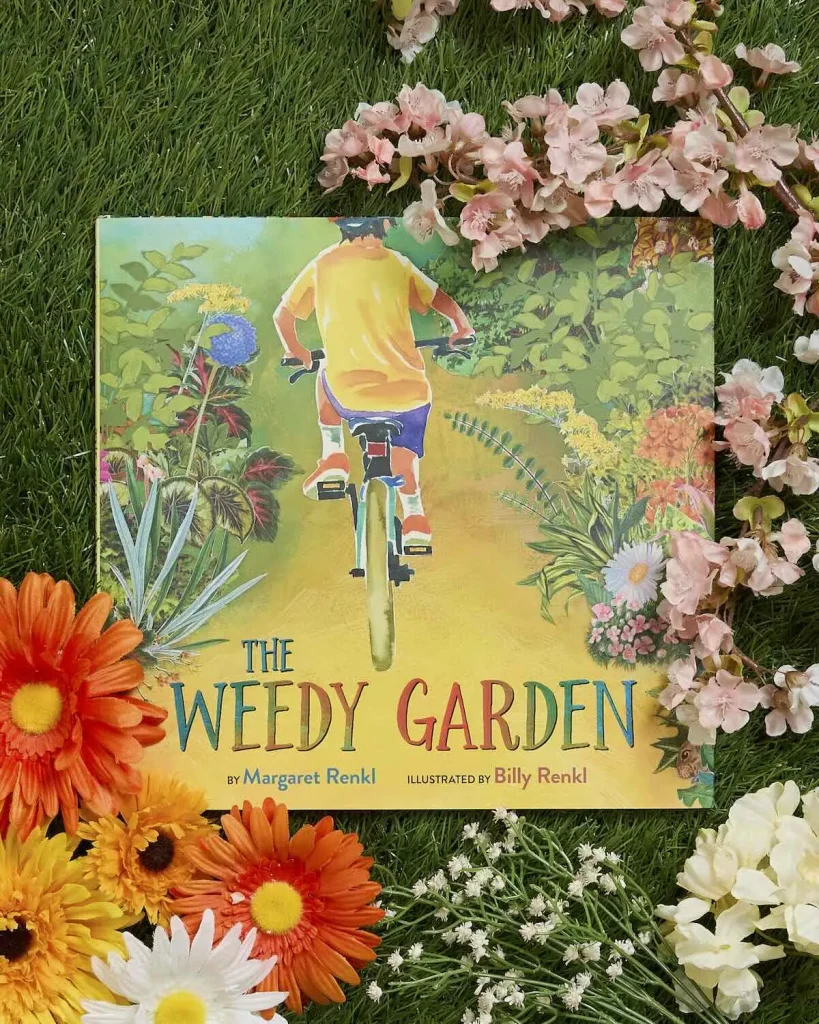
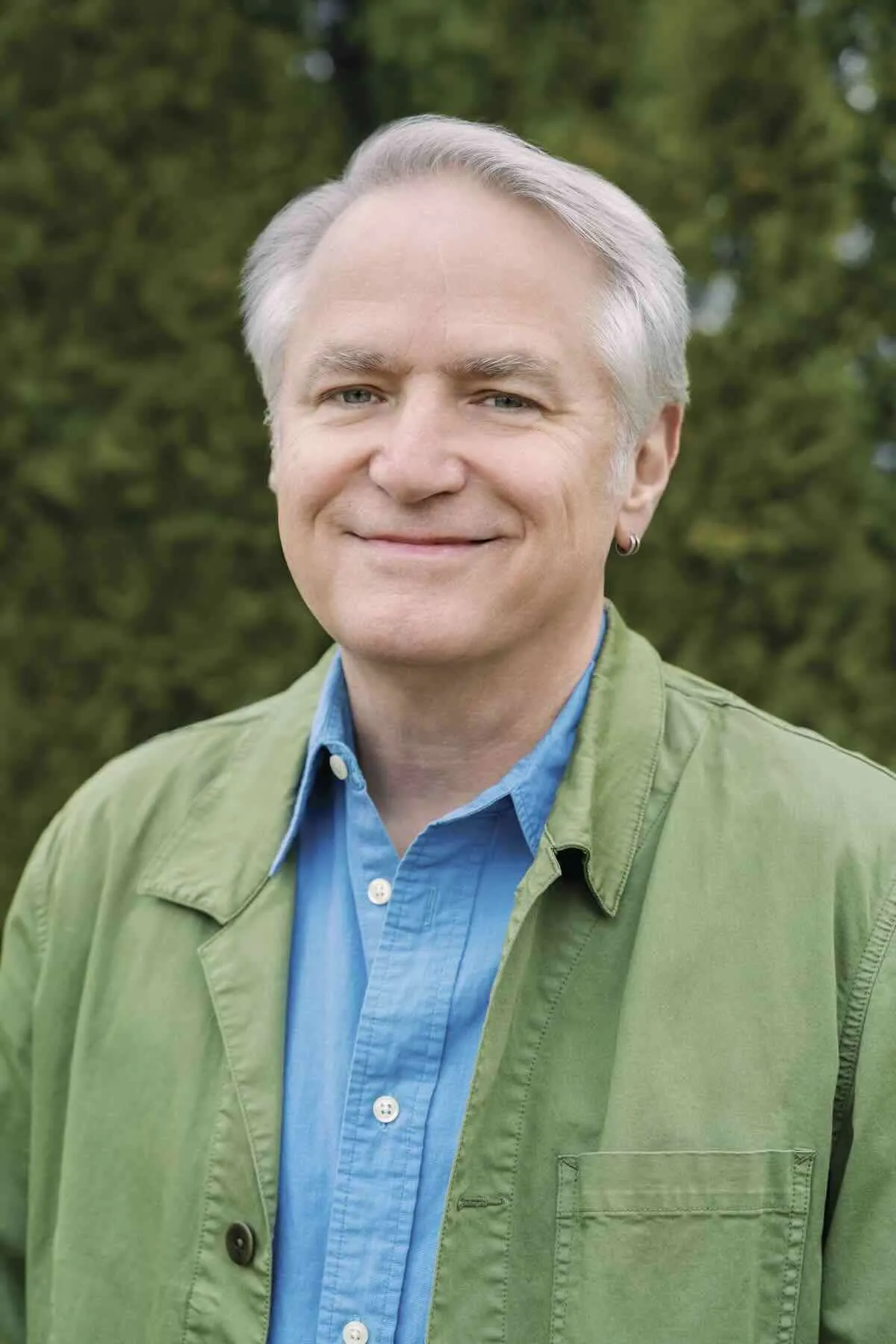
MARGARET RENKL’S newest book, “The Weedy Garden: A Happy Habitat for Wild Friends,” is aimed at children, but it’s really for everyone, she says. And indeed, we grownups, too, often need a reminder that our gardens are not just “our” gardens, but critical habitats for our wild neighbors.
How we manage these spaces determines whether bees and butterflies and frogs and fireflies and turtles and birds and everybody else out there thrives or not.
Margaret visited the podcast to talk about the new book and the message for humans of all ages that guides her approach to gardening.
Like many readers, I got to know Margaret Renkl in 2019 upon the publication of her book, “Late Migrations.” Since 2017, she’s been contributing a popular “Opinion” column to “The New York Times,” and she also published “The Comfort of Crows: a Backyard Year” in 2023, and now the new children’s book. She lives and gardens with an ecological focus in Nashville.
Plus: Comment in the box near the bottom of the page for a chance to win a copy of “The Weedy Garden.”
Read along as you listen to the March 2, 2026 edition of my public-radio show and podcast using the player below. You can subscribe to all future editions on Apple Podcasts (iTunes) or Spotify (and browse my archive of podcasts here).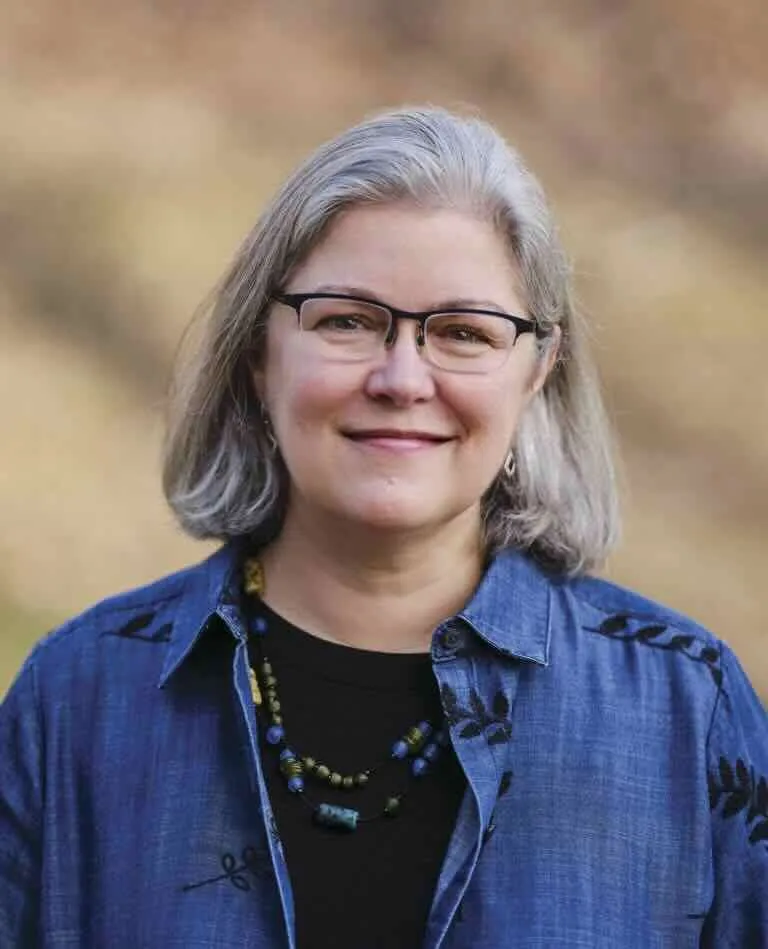
‘the weedy garden,’ with margaret renkl
Download file | Play in new window | Duration: 00:27:11
Subscribe: Apple Podcasts | Spotify
Margaret Roach: Hello, Margaret R. of the South, as I call you; my alter ego.
Margaret Renkl: Hello, Margaret R. of the North, as I call you. I mean, what are the odds? But it is just the silliest, but I’m sure you’ve had this experience, too: So often I’ve gotten email meant for you.
Margaret Roach: I know, it’s funny, right? Just before we start talking about the book, as a gardener who’s been through a number of severe weather events in my time, we all know about Nashville having had horrible, horrible ice and everything not so long ago, and all those trees; the pictures of all the damaged trees. And I’m assuming your garden was stricken as well, and all around you.
Margaret Renkl: Well, it’s a little early to say how the actual garden did. We leave the leaves where they fall, so it’s fairly well tucked in. But the biggest pollinator garden in my yard is built around a snag that we left standing at when a maple tree died in a storm, so it is very exposed. But we did lose not whole trees, I don’t think. We’re waiting for the arborist to come actually tomorrow to tell us if we can save our pine trees. But we lost so many limbs. I can’t even describe it, Margaret. The trees are… no tree was left untouched. We lay in bed that night and listened to limbs crack.
Margaret Roach: It’s like shotguns. I’ve been there in the dark and you’re just shaking in your bed, and it’s like shotgun blasts. Someone’s just shooting someone over and over.
Margaret Renkl: And then it hits the ground and the ice breaks and it sounds like glass shattering and you just think you’ve come to the end of the world.
Margaret Roach: Yes. Well, I just wrote a Times column about woodpeckers, and that’s what I’ve been working on recently. And the woodpeckers are happy when there’s a change [laughter], and when there’s damage, they like to take advantage of it. So maybe the woodpeckers, more woodpeckers, will move in and say, “Ooh, look at this. There’s a hole in this tree where their branch used to be and I’m going to do something about it.” So who knows? I like to try to be optimistic.
Margaret Renkl: Well, we have a lot of woodpeckers and in fact, right before the storm hit, there’s a pileated that comes and goes. We have an old pear tree that is not a Callery pear but a real pear tree, and it’s very old and very damaged and that woodpecker loves it.
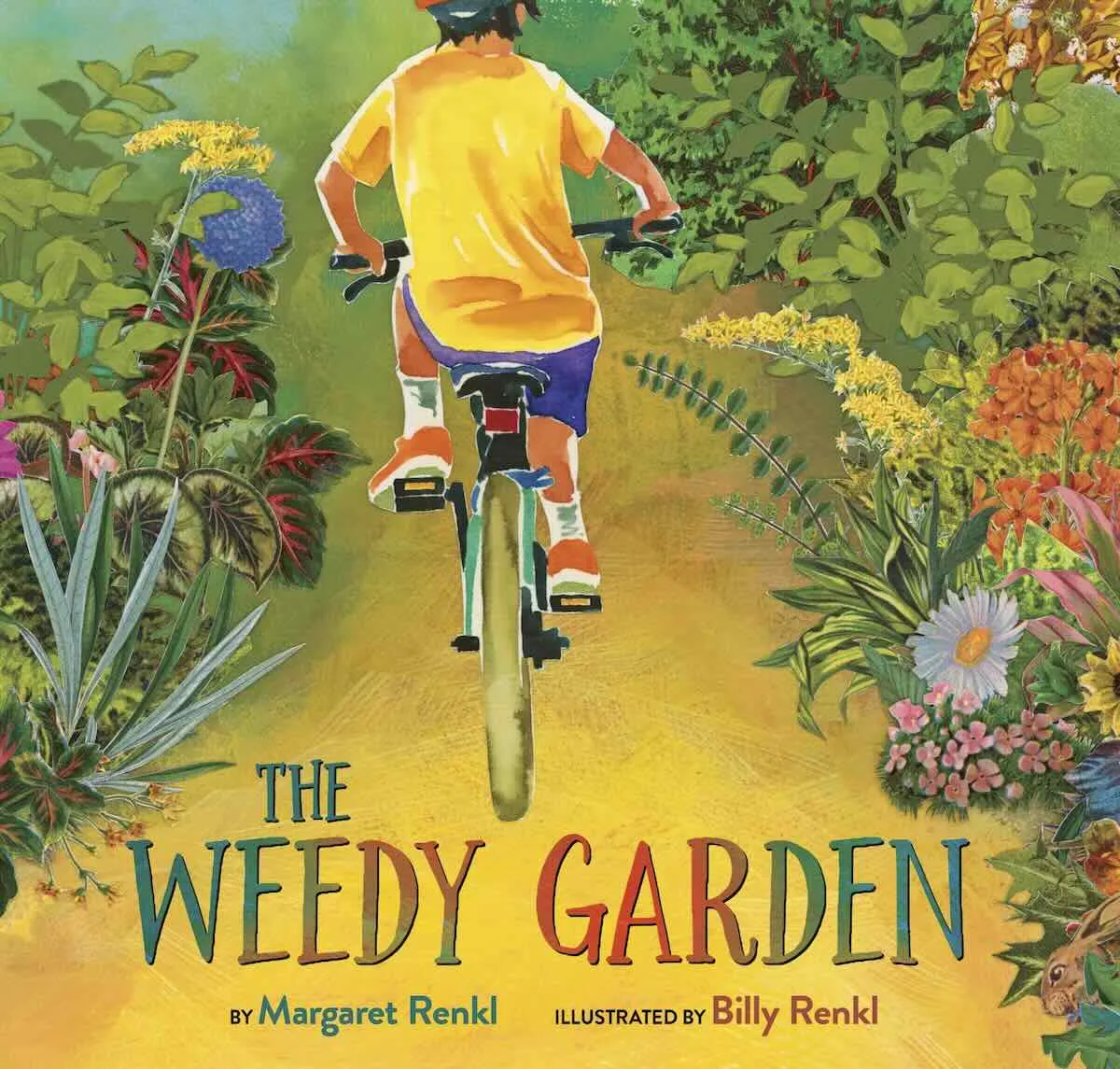 Margaret Roach: So the new book, “The Weedy Garden,” as I said in the introduction, it’s a children’s book, technically speaking. I got a lot out of it, though. So the new book is different from your others besides being a children’s book, it’s also a picture book created in partnership with your artist brother, Billy Renkl. So why a kid’s book? And what about that? Where did that come from?
Margaret Renkl: Well, in some ways I’m, I think I’m coming full circle. As a child, I loved books so much and in those days, or at least in my family, you just waited to let the school teach the child to read. And so I always felt I was at the mercy of the adults in my life to read to me, and they never were available to read as long as I wanted to be read to.
And so from the very beginning, even before I could read or write myself, I thought this would be my life, reading and writing the books I was interested in then. And back in those days, in the early sixties, there weren’t a whole lot of… There just wasn’t a lot of media for young children, and not so many picture books. But my father would read fairy tales and poems, and I just always thought right up through high school, I wrote my senior term paper on “The Wind in the Willows” and “Charlotte’s Web,” animals in middle-grade books.
And when I packed for college, I packed a huge carton of children’s books and that was going to be what I learned to do was how to write children’s books. And a lot of things, life happens, people happen. And I wandered away from the central mission. And then Billy [below] said to me, my brother, who’s a year younger than I am, “Well, could you write a picture book? I really want to do the artwork for a picture book.”
Margaret Renkl: In some ways I just came back to what I had always been.
 Margaret Roach: That’s interesting. Even though it’s called “The Weedy Garden,” it’s not a book with the text and the illustrations about weeds, like knotweed and kudzu and whatever. It’s not about eradication of things. It’s more about sort of things that give life to other forms of life. And so what is a weed in the context and the message of “The Weedy Garden”? What’s a weed?
Margaret Renkl: Well, I think you kind of hit it. We’re not trying to talk about pulling weeds, although I do pull weeds, and I know you pull weeds, but-
Margaret Roach: Just a few, Margaret [laughter].
Margaret Renkl: When you’re talking about creeping Charlie or you’re talking about henbit or you’re talking about chickweed or any of the other invasive plants that end up in our gardens, you’re talking about what I agree is a weed. But then when you’re talking about wildflowers, often they are considered by other kinds of gardeners also to be weeds. So there’s butterweed and there’s ironweed and there’s milkweed, and there are all these plants that actually have the word “weed” in their name, in their common name, because our ancestors considered them to be unwelcome in their gardens-
Margaret Roach: Or at least wild if not—I mean, they were for the wild places, right?
Margaret Renkl: Right. But I plant them and carefully move them if they get planted by the birds or the chipmunks or the squirrels somewhere else. Because when you are gardening with wildlife in mind, then you have to, as you know so well and have written about so beautifully and so persuasively, so many times we have to plant the plants they need.
And obviously some plants are better behaved than other plants, and you probably don’t want common milkweed right in your perennial border. But if you can find a place where common milkweed is in the right conditions and has room to run, then you’re going to have a whole lot more monarch butterflies, because those leaves are mammoth compared to butterfly weed or compared to swamp milkweed, the other two varieties, and honey vine milkweed that I have in my yard.
Margaret Roach: And it really is true if you plan that, they will come. It really does work. It is a system of related organisms who have co-evolved and know one another, their ancestors know one another. I mean, I’m anthropomorphizing or whatever, but you know what I mean.
Margaret Renkl: I don’t actually think you are anthropomorphizing. I think we made a mistake somewhere along the way when we stopped thinking of the natural world and natural systems as living beings. They do have individual personalities. Some squirrels are definitely a lot more lot bolder than others. And so their individuals and their little life cycles are just as important to them as ours are to us.
You see that when you welcome them. You get to be in… You get to be a wild thing yourself in a way because you see yourself as part of this ecosystem when you can get close. And Billy likes to say when he was working on the illustrations for this book, that he was careful with each spread to try to come up with different perspectives, to be looking at the garden from, with the idea that little kids are often just squatting and looking right at eye level to a zinnia.
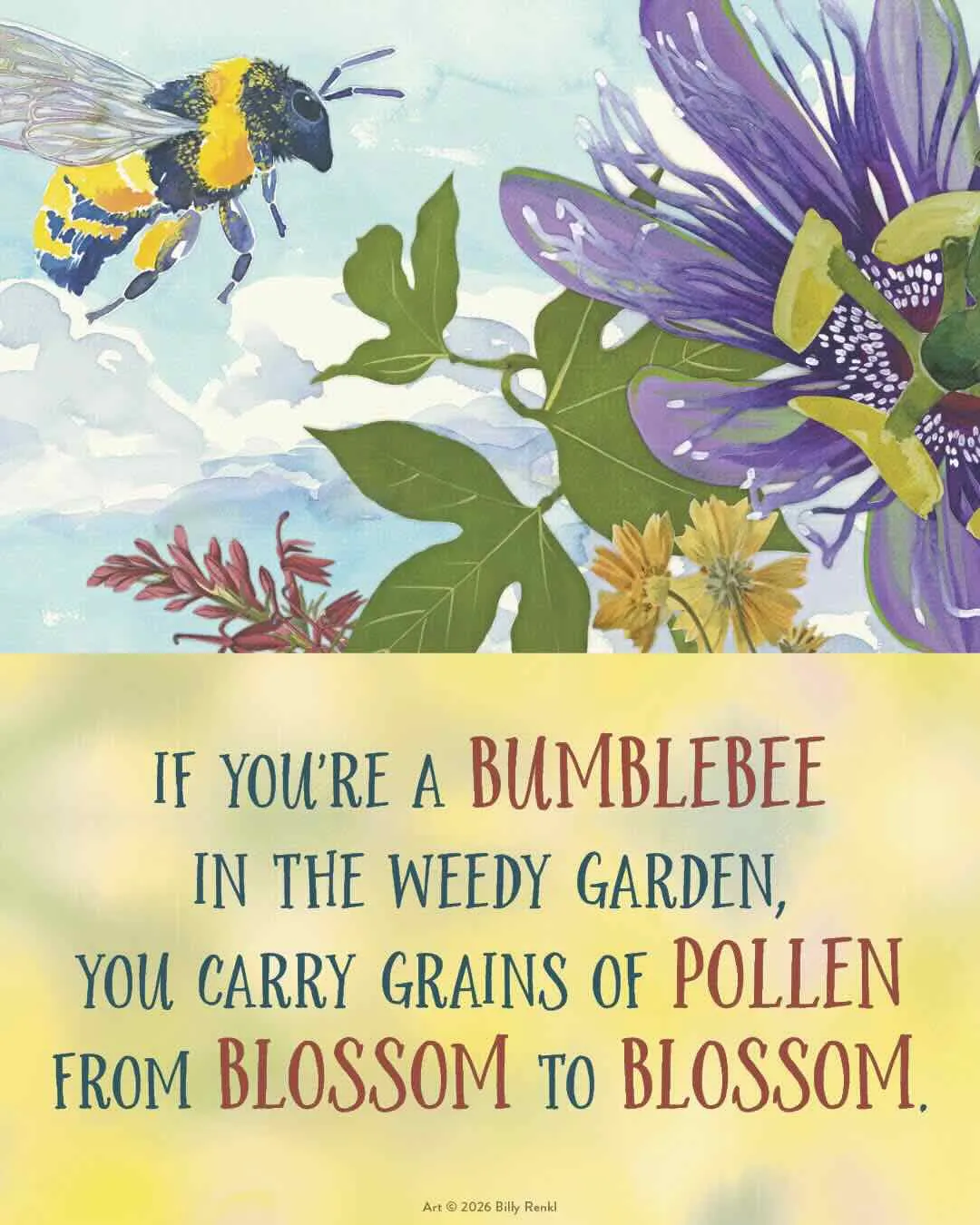 Margaret Roach: Yes, yes. No, totally true. And the way that the book, it’s kind of a big book when you open it up, it’s a two-page spread; each sort of illustration is a two-page spread. And beneath them, stretching across the bottom of the two pages is a line of prose. I don’t know, maybe it’s poetry. I’m not really sure what you would say you’re writing [laughter]. And it starts with an “If you’re…” and it’s one of the creatures.
I love the one, “If you’re a bumblebee in the weedy garden, you carry grains of pollen from blossom to blossom. You’re a seed maker dusted with magic. You’re a flower farmer dressed in gold.”
So there’s this picture of a bumblebee and engaging with a flower and all this stuff going on in the illustration. But there’s also this, “if you’re this creature, this is what’s going on for you.” And this connection, this expression of connection, I guess. And I just loved you have the toad, the speckled toad, who’s there sort of crouching and hidden from the bugs, waiting quietly without moving and all of these creatures. And I assume that you’ve had the privilege of discovering them all because of your relationship with your own garden.
Margaret Renkl: Oh, for sure. Not just my garden, but going back to childhood, we don’t have any toads in our yard anymore. I haven’t seen a toad in this yard in probably 20 years. My neighbors use too much pesticides. And there’s never been any sort of chemical on this yard, but half an acre is not enough to sustain an amphibian ecosystem. So some of these are memories more than they are direct observations.
But I’m glad you noticed the little line at the bottom of each page, because the one thing I knew starting out: Billy wasn’t asking for me to write a picture book about any particular subject. I just thought, I just like writing about the natural world. And I thought secretly—I’m confessing here, Margaret—that if the grownups aren’t listening to us, maybe we should deputize an entire nation of second graders and let them loose on their appearance to sort of explain why you need to keep that particular flower and put the spray bottle away.
But with the limited amount of text, partly that was just because I think you don’t have to worry so much about the vocabulary level of the child being read to when you have a read-aloud book, like a picture book. But it can’t be too many words or you lose the littlest ones. And so it kind of happily coincided that I wanted to write a picture book for my brother, but that I also wanted to leave the canvas as big as I could for him. And that necessitated limiting the number of words.
So the actual story is only 200 words, and then there’s another 300 words of back matter, but it’s really for the adults who are reading the books to the children. But for me, it was just I wanted to give Billy as much room to spread out as I possibly could. He is a passionate gardener and he has maintained—I think we’ve even talked about this in past conversations—a really elaborate garden journal. And so I was really looking forward to seeing what he could do with a big canvas.
But as far as the language itself, I was stymied for quite some time. This is a hard form to write in, and I’ve already written the second one in this series, and it was not any easier writing the second one than it was the first time [laughter]. It’s a hard when every word has to count and you can’t risk boring your audience for even. You can’t say, “O.K., well, my audience is going to hang in with me here and they trust me. They’ll know I’m going to come around to the point.”
No, that’s not true for a 4-year-old. So I had to be really cognizant of making every word count. But then I had this conversation with the great children’s writer, Kate DiCamillo, and I said, “I don’t know if I could do this.” And she said, “Think of it as a poem with page turns.” And that really did just unlock it for me.
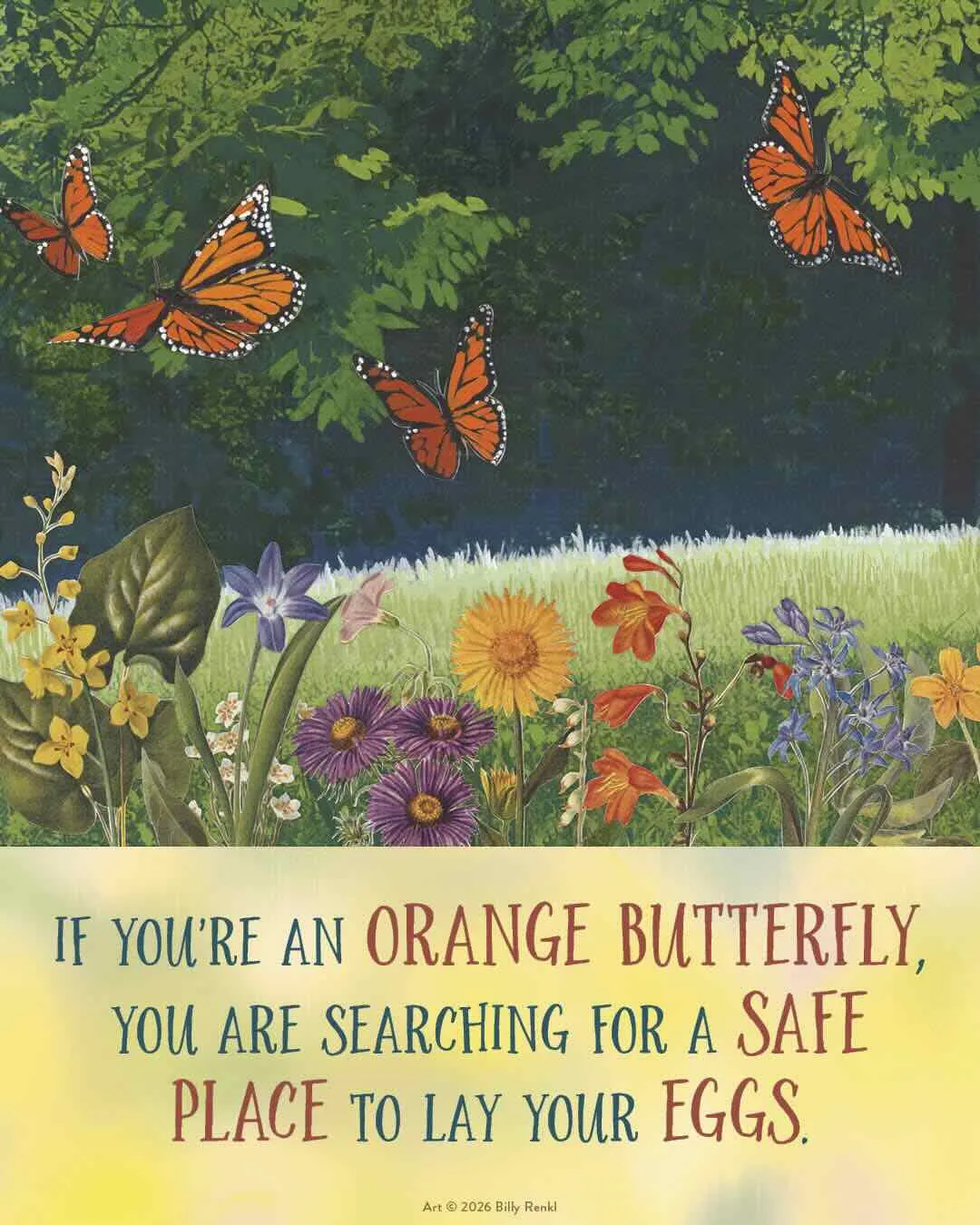 Margaret Roach: Yeah, that’s interesting. That’s a good description of a children’s picture book like this then. Yes, “a poem with page turns.” Yeah. Good. And again, each spread depicts one creature, and there’s a green snake, I think, and there’s a turtle I think, and the bumblebee I mentioned, and I forget, there’s the toad I mentioned and lots of different animals. And you’re kind of zeroing in on how they relate to some aspect of the place, but it’s not the way that we humans—and you were talking before about how kids are on eye level with some of the things—and their perspective, these small creatures is different. Again, they have their own way of seeing it and proportionally, their proportionally relationship to it is very different.
And some are rustling around in the leaves, as you were saying, that you’ve left on the garden floor, and some are buzzing about above. And it’s all these different perspectives. And I think a lot of times we get obsessed with, “Oh, well, that bed doesn’t look colorful this month.” Or, “Oh, this isn’t pretty enough or whatever,” and we forget there’s a million other things going on if we would just stand still and look closely.
Margaret Renkl: And also the thing about children is they don’t have any value attached, of any good or bad, to anything. They’re just curious. They don’t know. They’re supposed to be afraid of the garter snake. They don’t know that the bee might sting them. They’re just curious about all of it.
And that’s one thing that does make writing for children especially rewarding, is that they’ll go with you. I think. I mean, I’m about to find out, but I think they’ll go with me because that’s just where they already are. People when I’m on book tour with a book that, especially a book that the natural world features largely in, often ask me, “Did you teach your children these things?” And I have to laugh because in so many ways they taught me.
Like all children, I was very interested in wild things when I was little right up to probably middle school, and then it was more schoolwork and friends. But when my kids were little, they brought me right back to those days of squatting and watching an anthill, or following a bumblebee to see where it goes next.
Margaret Roach: Well, and there’s so much that we miss. I mean, I’ve been in the same place approximately 40 years, garden seasons or whatever. And I think it was late last winter, I was outside doing something with a friend. We were doing some chore or whatever, and I looked down and I thought: That’s moving. There’s this big strip of grayish-blackish stuff, but it’s undulating, it’s moving, and it’s really long. It’s all along the base of a wall, and what in the heck? And it turned out to be millions [laughter] of little arthropods of some kind, and I had to go look up who they were, and do you know what I mean? It’s just like, even though I’d been here a million times, I’d never seen whatever. I can’t even remember what it was [it was snow fleas, or springtails]. That’s how silly I am.
Or the first time I went out at night and looked for moths, put up a light and looked for moths and found all these other creatures of the night here. I’d been here all these years and I didn’t even know about the night shift who lived here. So many of the creatures don’t even come out during the day. We don’t even see them. Right?
Margaret Renkl: And don’t you find, too, that the more you see, the more you see? The more you’re open to seeing something. Because it is true: You can’t step into the same river twice. You definitely can’t step into the same garden twice. Because I remember one time this giant, giant grasshopper showed up in my flower beds and I had never seen anything like it. And I went and looked it up, an obscure bird grasshopper just flew in and then later flew out again and hung around for two or three days and then it was gone. And I’d never seen such a creature before, and I haven’t seen one since.
Margaret Roach: And so the message then of the book is you’re trying to catch the attention, of course, of the little ones who are having this read to them or who are paging through it, but also of the person reading, yes? The person reading to them: the parent, the older sibling, the grandparent-
Margaret Renkl: The teacher.
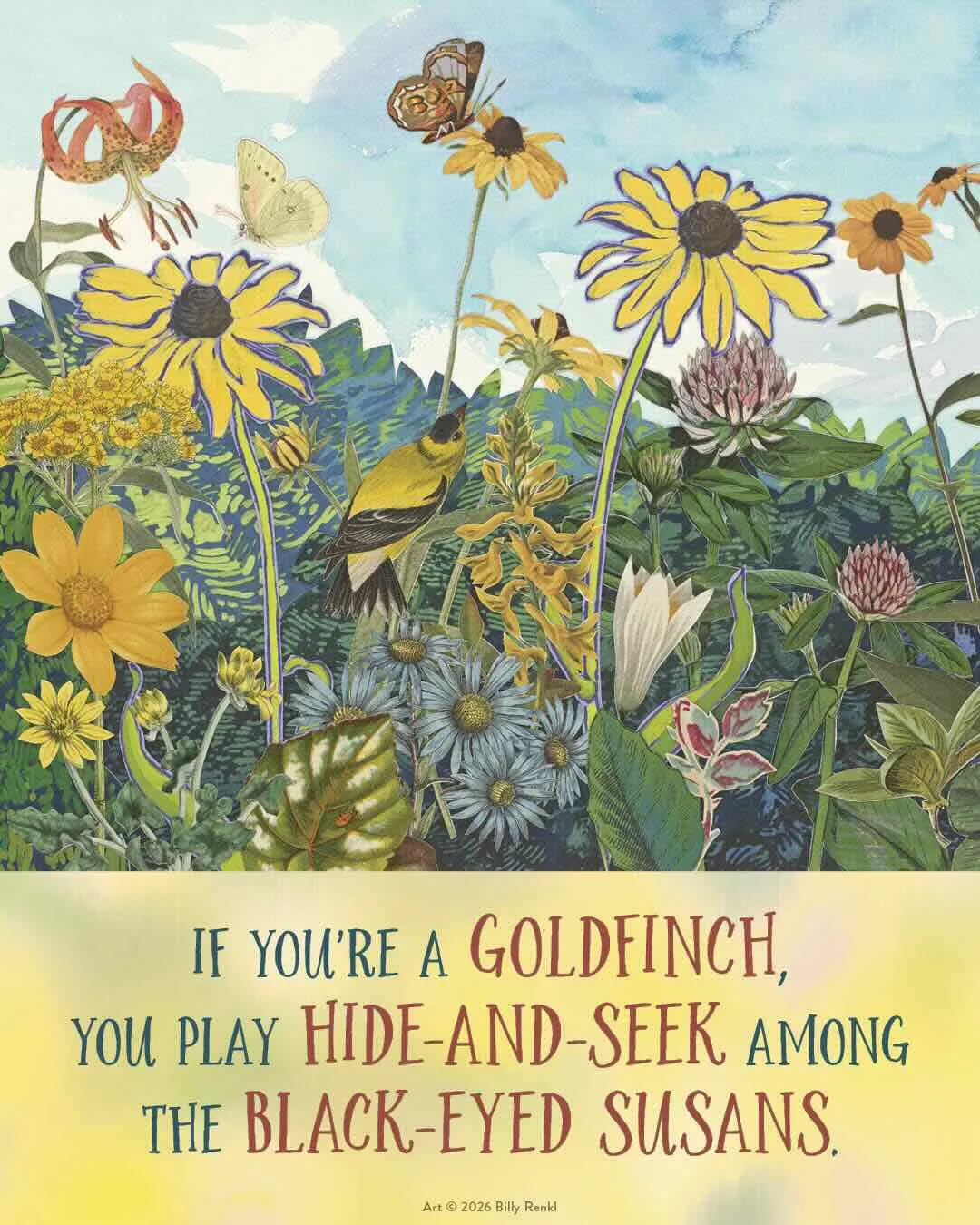 Margaret Roach: The teacher, right. And the overriding message then is—because again, each spread starts with “If you are a…” and then names a creature, a goldfinch, or again a turtle or whomever, the overriding message is what, do you think?
Margaret Renkl: I think it’s that we belong together. We belong to one another. This is the way it all works, and we’re part of it, too. And I think children understand that instinctively, but I think most adults have forgotten, and they think of the good bugs and the bad bugs, or they think about the things that are pretty or cute or the things that are ferocious and predatory. And they don’t realize that the really pretty, cute bluebird is just as ferocious on grasshoppers as any sort of hawk is toward bluebirds, or owl. I do steer pretty clear of predation in this weedy garden because I don’t really want to get too disturbing, but it’s-
Margaret Roach: It’s not a murder mystery, right? [Laughter.]
Margaret Renkl: No. But just the idea that if you pay attention, you’re going to find really amazing, miraculous things. And if you aren’t interfering with that process or those processes by interrupting them in some way, either chemically or by hand, then you’ll be privileged to see whole cycles play out.
And that there’s a reason for why the toad holds very still in those leaves and looks, in fact a lot like a mottled leaf, because he’s going to get that fly he can’t let the fly know he’s there. A lot of it is just about not in any sort of 2-by-4 across the head sort of way, but just a gentle celebration of the way everything is interconnected.
And then I mentioned the back matter. This is a pretty standard thing these days to include in a book that has information of any kind in it. It’s just a little bit more detail for the adult reading, explaining the relationship between native plants and native insects, and natives and native birds, and native birds and native mammals and reptiles and amphibians. And as with any picture-book writer, I believe I did immerse myself quite deeply into the world of picture books for about a year and a half before I tried to start writing.
Margaret Roach: Oh, interesting.
Margaret Renkl: They all seem to have this. There’s so much more than you can say in the length of a picture book, but there are plenty of resources for anybody who wants to know more.
Margaret Roach: I wanted to ask you, you have another book already in the works that’s going to be following this one, another picture book of the same kind?
Margaret Renkl: Yes. It’s coming out next year, towards the end of summer. Billy’s making the artworks for it right now. It’s called “The Leafy Blanket.” And I figure many of these same creatures from “The Weedy Garden” as they prepare for winter.
Margaret Roach: Leave the leaves and all that [laughter].
Margaret Renkl: Exactly. We can summarize the lesson from that one very easily. Yeah,
Margaret Roach: “The Leafy Blanket.” Oh, I love it. Well, it’s beautiful. And these are collages I think that he made aren’t they?
Margaret Renkl: They are collages. Some of the elements, unlike with our other two books, he did hand-paint many of these elements,.
Margaret Roach: They’re amazing. Well, congratulations, and thank you, and I hope I’ll talk to you again soon, Margaret R of the South [laughter].
Margaret Renkl: Thank you so much for having me. I love being on your program.
prefer the podcast version of the show?
 MY WEEKLY public-radio show, rated a “top-5 garden podcast” by “The Guardian” newspaper in the UK, began its 16th year in March 2025. It’s produced at Robin Hood Radio, the smallest NPR station in the nation. Listen locally in the Hudson Valley (NY)-Berkshires (MA)-Litchfield Hills (CT) Mondays at 8:30 AM Eastern, rerun at 8:30 Saturdays. Or play the March 2, 2026 show using the player near the top of this transcript. You can subscribe to all future editions on iTunes/Apple Podcasts or Spotify (and browse my archive of podcasts here).