
Growing year-round profitability. A brief context to set expectations.
Growing year-round profitability: Quick notes
A highly functioning soil leads to better freeze resistance for crops, and the soils themselves are better able to resist freezing due to the heat generated by the soil life and the aggregation of soil structure. This moderation of soil temperature due to biological activity is critical for successful off-season crop growth. As well, the common darkening of the soil color as fertility develops is better able to capture the sun’s warmth than a lighter-colored soil. When soils are functioning to this level, winter vegetable production becomes much more possible. Trying to grow winter vegetables on weak soils is particularly challenging.
Vegetables capable of saturating their saps with an additional sugar lode improve greatly in flavor upon the onset of frost or freezing conditions. Crops that are unable to do this simply die when temperatures hit the freezing point. The increase in sugar content and improvement in flavor at the onset of cold weather does not go unnoticed by the customer!
This is a time when vegetables grown in cold climates can vastly differentiate themselves from their warm- region counterparts. Carrot, cabbage, parsnip, leafy greens, brussels sprout, turnip, and rutabaga are a few well-known examples of crops that sweeten up in cold weather. It is generally true that the colder it gets, the sweeter the vegetable, but beyond a certain cold threshold plants will suffer damage.
This damage may be temporary, such as water-soaked–looking areas in leaves that may develop following a frost. In vigorous crops these areas rapidly recover once temperatures rise above freezing, but at some point damage can become permanent. The temperature that leads to permanent damage varies among crop species and varieties, as well as the degree of plant vitality. This is another reason that careful soil and environment management, as well as seed breeding, are priorities for growers who embark upon year-round production.
Planning the layout of the cold-season vegetable production area is of even greater significance than designing field layout for the warm season. In the cold season the sun moves in a low arc across the southern sky, which may result in shading difficulties not encountered during the warm season. The cold season is also often a wetter season, creating more challenges in managing soil water. With the lack of foliage on trees and loss of their wind-moderating influence, cold winds can also lead to damage.
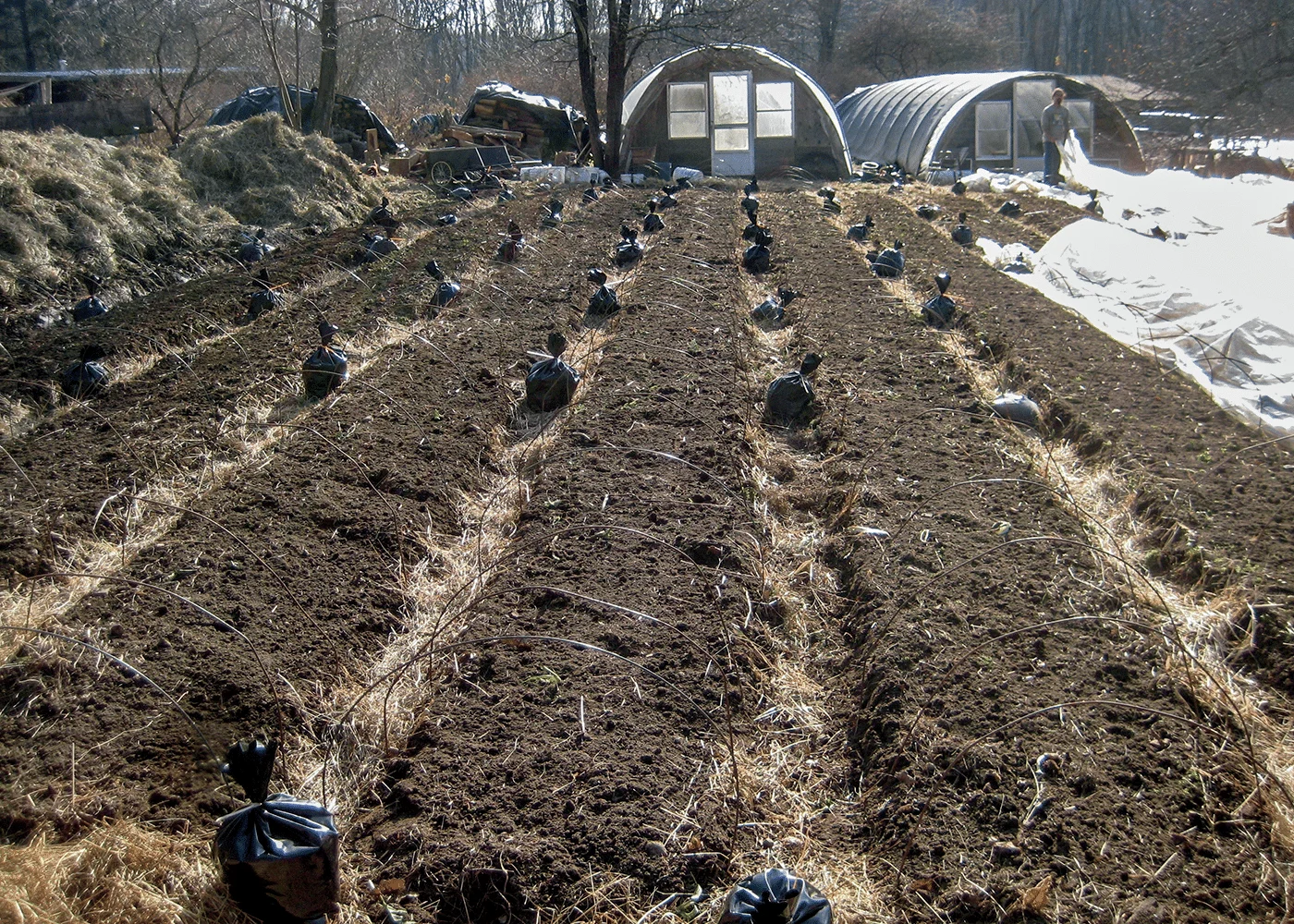
Beds laid out for low tunnel assembly. Bags first, then hoops, then covers. This picture dates from our tillage days. Straight raised beds with exposed soil surface, mulched wheel tracks to keep weeds out and prevent bags and covers from freezing to the ground. The field does not look like this anymore.
Full southern exposure and a slope toward the south can be particularly useful in collecting sunlight during the cold season. Fields thus situated are by far the best positioned for year-round growing. Drainage management is crucial due to increased moisture in the cold season, which is potentially damaging to crops.
Raised beds, arranged appropriately if on a slope, and soil aggregate development are primary to optimize drainage. Subsurface tile drainage in the field or ditches around the growing area may also be beneficial because groundwater levels in winter can be high.
The development of appropriate windbreaks, as described in chapter 1, for cold-season growing is also of a high level of importance.
In the last few decades, new types of structures have largely replaced glass greenhouses and cold frames. Clear plastic polyethylene sheeting is frequently used for covering greenhouses. Low tunnels covered with this sheeting have largely replaced cold frames.
Polypropylene cloth row covers have supplanted the woven straw rolls and mulches of the past. These modern materials are popular because they are very efficient and are sold at a relatively low cost. Unfortunately, they are relatively toxic to manufacture and dispose of and are capable of leaching plastic compounds into soils and plants.
It appears they are more capable of off-gassing and leaching when new, much less so when aged. This movement of plastic compounds into the growing environment does not appear to be excessive and the functioning soil environment is likely to decontaminate in a timely manner, but still, less is probably best.
The benefits of polyethylene and polypropylene sheeting are extensive. With proper application the materials can increase solar heat gain, retain soil warmth, and decrease or eliminate cooling winds. They also serve as a barrier to excessive moisture and thus create drier growing environments. Clear polyethylene sheeting is superior to polypropylene row cover in terms of capturing solar heat, eliminating cooling winds, and blocking moisture.
Row cover is superior for retaining warmth for nighttime protection, and can be utilized without supporting hoops, which often makes it easier to work with in a field setting. Depending on which conditions are sought, the materials can be used in sequence, or even in combination.
Recommended Reads
Back to the Roots: A Return to the Roots of the Organic Method
Low Tunnel Tutorial: Winter Growing DIY
Growing year-round profitability comes up here to connect ideas for clarity.
We reference Growing year-round profitability briefly to keep the thread coherent.










Also · I appreciate the point about “Growing Year-Round: Profitability & Tips” — very helpful. Great share.
PS – Yes, that small tip really helps.
PS – Yes, that small tip really helps.
PS – Yes, that small tip really helps.
PS – Yes, that small tip really helps.
Quick thought — Lovely composition; the colors work so well together. So cozy.
Heads up • What a charming tip — I’m inspired to try it. Saving it.