Always be modeling — a short introduction to this piece.
Always be modeling: Quick Notes
One of the many benefits of woodworking as a hobby is the privilege of customizing furniture to fit your house. You can make a unique piece to fit a unique room. See also Gesamtkunstwerk, of which I’m an adherent, somewhat to the annoyance of my forgiving spouse.
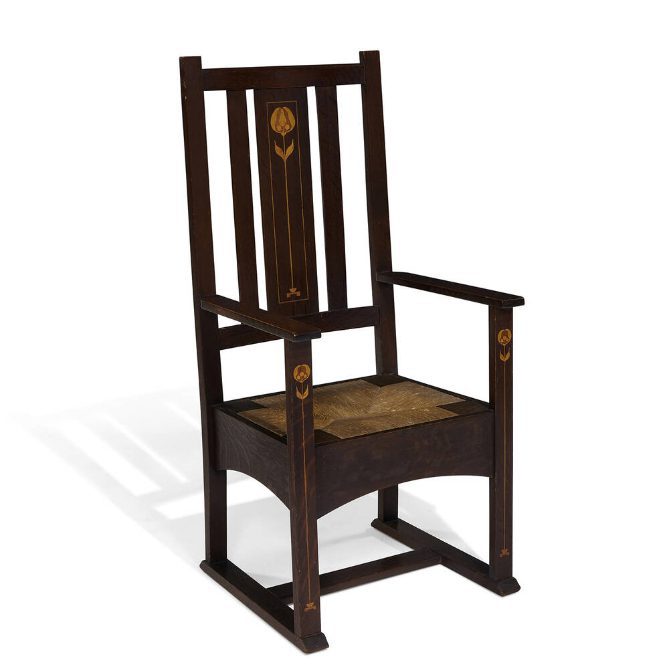
Most, but not all, of my furniture pieces are reproductions often extracted from auction photos. I spotted the Stickley chair with inlay, designed by Harvey Ellis, at the top of this post and immediately wanted to make a copy. I suspect this chair was a one of a kind prototype that I thought would make a good dining room chair to replace the thrift store chairs that offend my vision every single day.
To do all this pretentious Gesamtkunstwerking takes forethought. Wagner didn’t toss off those operas in an hour, after all. As a wise shop teacher once said, “always have a plan.”

Towards that end I recently spent a few days reviewing the finer points of the 3D modeling program Sketchup. I’ve used it for years but it really helps to know, in detail, what all the tools do and also to commit to memory the many keyboard shortcuts. FYI: the Los Angeles Public Library, like many other libraries around the U.S., offers free digital resources including Linkedin Learning (formally Lynda), which has a great Sketchup class.

Note–the chair rails would have curves that I did not cut in the model.
Chairs, even rectilinear examples like this one, are complicated objects with many oddball angles. They also are subject to more stress than most furniture as we haul our heavy asses up and down out of them many times a day. Due to all these angles, the 3D model took longer than usual. That this chair also has intricate inlay work means a big commitment and I wanted to make doubly sure that the chair would work in our house so I also took the step of making a full scale model out of scrap wood.

Cat for scale, but the photo does not do justice to how ridiculously oversized this chair seems in our tiny house.
I’m very thankfully I made this janky model as it became immediately apparent that the chair would be way too big for the room. It’s like something for your Edwardian era baronial dining room, not a scrappy Los Anglees bungalow. I’m a lowly blogger, after all, not a captain of industry.
While I’m disappointed the chair won’t work, I’m happy I didn’t waste wood and a lot of time. Thankfully I spotted a very strange chair from the same period in the De Young Museum in San Francisco and I think I might draw up a model of this chair. Story to be continued . . .
Related Posts
Always be modeling appears here to highlight key ideas for readers.