Choose trees wisely.
Experts share design — a short introduction to this piece.
Experts share design: Quick Notes
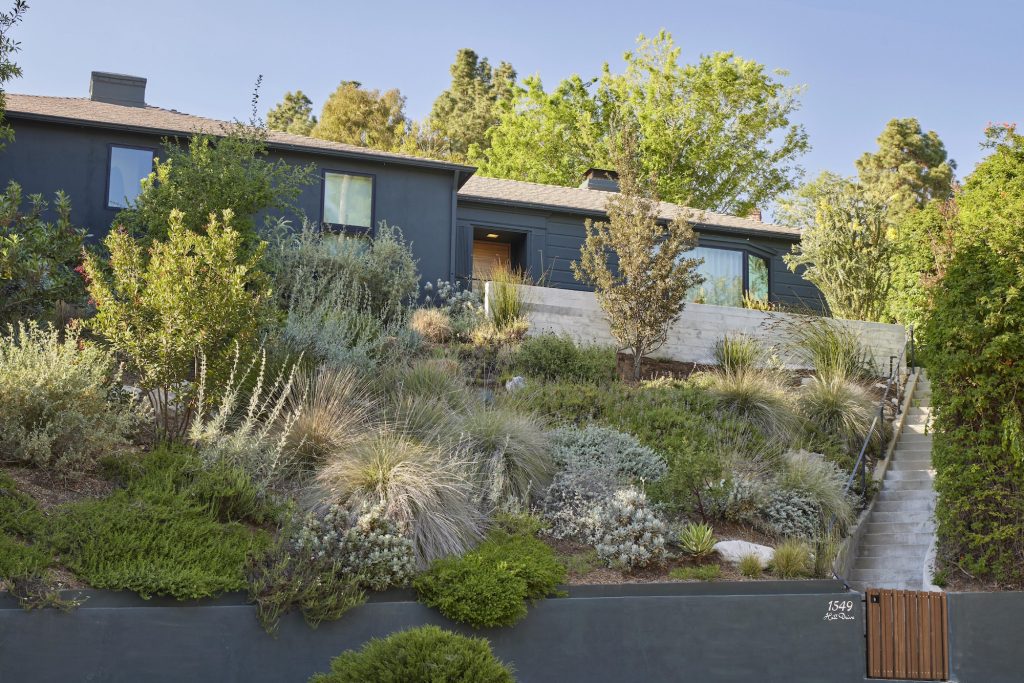
Selecting trees appropriate to your conditions is especially important on a slope. For example, Refugia chose trees that could tolerate rocky, dry soil and that are adapted to disturbed areas, like Eastern red cedar, for their hillside project. Branum notes that smaller trees are also easier to plant on a hill: “We were careful to purchase trees that were not too large for us to handle on the steep slope.”
Create planting shelves.
Campbell advises that you need to take care with your technique when planting into a hillside. “You have to scoop out a flat zone, to create a reservoir to catch the water–every plant needs to have a little plateau and a reservoir,” she says. To create these “planting shelves,” you will dig into the hillside to carve out a flat area for the plant; then place the excess soil downhill creating a berm-line ledge.
Use boulders to slow water flow.

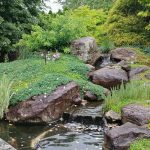
Campbell incorporated boulders into her design to help direct the flow of water when it rains. “They create a filtration system of sorts,” she explains. “There’s a flatter zone right behind them that water would hit and it wouldn’t just immediately go downhill. Instead it sits behind the boulders and permeates into that area and then drains down to the lower level.” Campbell chose boulders that could be moved by three or four people with ropes and pulleys, since they didn’t use any machines.
“Right plant, right place” is even more important.
Take all of the conditions–not just the slope–into consideration when choosing plants. In addition to working with a sloped piece of land, Refugia’s clients had dry soil (a common occurrence in places where water naturally drains away). “We chose plants that would be drought-tolerant like St. John’s Wort, prairie grasses, and eastern red cedar,” says Branum.
Take advantage of flat areas.

Both Campbell and Branum took advantage of flat areas at the top of the hill to create usable gardens. Campbell added a stem wall (stabilized with rebar) that they backfilled to expand the flat land by the house’s entrance.
Plan for extra labor.
Vogt notes that one of the biggest challenges for a hill sit is “just walking on the slopes, holding drills and drilling plugs.” Likewise, Campbell describes how every shrub and tree had to be maneuvered onto her site with ropes and pulleys, since using machines on the fragile hillside wasn’t an option.
See also:
(Visited 3,596 times, 965 visits today)
Experts share design appears here to highlight key ideas for readers.
<!–
–>