
I ALWAYS SAY that birds taught me to garden as I watched their behavior and added more of the plants and features they seem to like and use most. And I’ve been blessed to have a diversity of avian visitors over many years.
One place I’ve long turned for all kinds of information about birds is Cornell Lab of Ornithology. And lately among their many educational resources, they’ve added the Garden for Birds Project, loaded with reference materials and inspiring webinars and more. The project’s leader, native plant specialist Becca Rodomsky-Bish, filled me in about its offerings and suggested some of the more impactful tactics for making your own landscape into a garden for birds.
Becca has been gardening for more than 20 years. She draws upon her background in environmental science and her native plant expertise to manage her home garden and shape the offerings of the Lab’s Garden for Birds Project.
Like everyone I know who gardens for birds, Becca reports not just an uptick in sightings of feathered visitors, but also in the positive impacts the practice has had on her life, not inconsequential effects like hope and joy.
Read along as you listen to the April 6, 2026 edition of my public-radio show and podcast using the player below. You can subscribe to all future editions on Apple Podcasts (iTunes) or Spotify (and browse my archive of podcasts here).
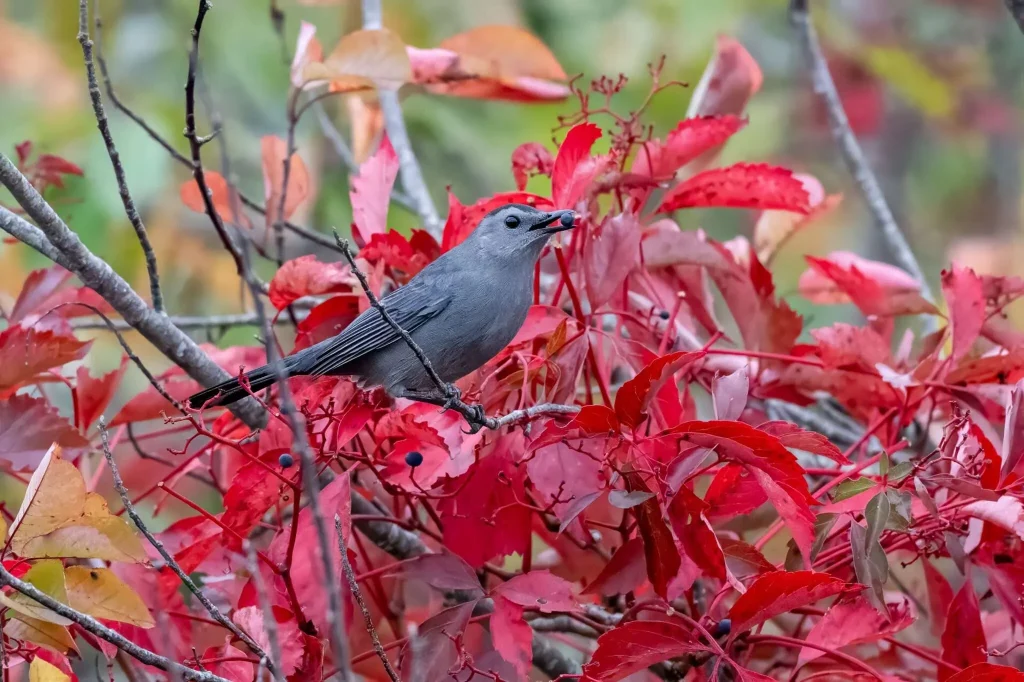
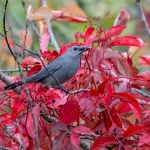
(Above: Gray catbird on Virginia creeper (Parthenocissus quinquefolia) displaying its fall color. Photo by Emily Turteltaub Nelson / Macaulay Library.)
 welcoming the birds, with becca rodomsky-bish
 welcoming the birds, with becca rodomsky-bish
Download file | Play in new window | Duration: 00:26:30
Subscribe: Apple Podcasts | Spotify
Margaret: Hi bird lady, sister bird lady. How are you?
Becca: Very well, now that the birds are returning, right?
Margaret: They certainly are. Lots of action out there. So to get us started, I thought, of course, give us sort of the short intro, the short version of how do you introduce Garden for Birds? What is this project?
Becca: Yeah. Well, like you, as you said, I’m very passionate about birds. I would say they really taught me to garden, too. I share that thread with you. We know people love birds, right? The Cornell Lab has fortunately been at the front runner of that growth of love. And Merlin is a tool that many, many people use now. And so at the Lab, we understand that birds can be a really powerful hook and a powerful motivator.
And so one of the things we’ve been discussing a lot at the Lab is our goal of really trying to get people to take more concrete action in the ways that they can to help birds. And what better way to possibly do that if you have access to any kind of a green space, or even just a portrait or patio, is to actually put resources and habitat features out that birds are attracted to and can be safe in and around using and hopefully provides access to resources that they need in order to go about their very busy, curious, amazing lives.
So Garden for Birds is really born out of that. It’s born out of how do we use this love of birds that we see growing really around the world and inspire more and more people to actually take some action to help those birds, because we can. That’s one of the beauties of this. Like you said, there’s a lot of hope and joy in recognizing that we can have a role to play in this space.
Margaret: Yes. And I joined Garden for Birds; it’s something that one registers for, we can register for it. And I saw that I’m going to get a monthly newsletter and I sort of clicked around the website and there’s all these resources, information. I mentioned in the introduction that there’s webinars, both some older ones that are recorded and they’re from people like Doug Talamy and Benjamin Vogt and all kinds of people. You just had a recent one, I believe, with Heather and Zoe Evans of Design Your Wild, who have that Substack newsletter, and they did sort of a design webinar. I think I’ll embed that with the transcript of the show [below] because that was fun that you hosted.
So there’s lots of stuff, how to access plant lists for your region and design ideas, people’s before-and-after photos. So lots and lots and lots of stuff. Yes.
Becca: Yeah, exactly. And really a lot of what you articulated is about sort of helping and supporting people, which though this project is only in its official second year, we’ve really been doing research to try to launch this project since really 2023, because a lot of this work is about understanding what people need in order to be able to even engage in this.
You and Heather and Zoe and Benjamin and Doug and a lot of us are already deep into this work. But for somebody who’s not, who’s coming in for the first time and has really good intentions, it can be very confusing. And what should I plant? What shouldn’t I plant? What will work, what won’t work, etc. So as much as this project has been about the birds, it’s also about the people, and trying to understand our audience and trying to understand what people at different degrees and levels of expertise in gardening, what they need in order to engage in this work.
Margaret: Right. And I think it connects to eBird. Since there’s been eBird, I’ve had an eBird account and I put my sightings in and whatever. And I think I can connect the Project to my eBird account as well if people are eBirders. Is that correct?
Becca: That is correct. And that’s one of the points of this effort that gets into the participatory science piece that we of course are really excited about at the Lab because we are all about that. Doug and many other researchers, Desiree Narango…we have research on how changes in plant choices in our landscapes and monitoring birds can have an impact on them on sort of these isolated research projects.
But what we would love to be able to do is to make that bigger and say, “Here are people around the United States and Canada who are a part of a project where they’re intentionally creating habitat for birds. And because of that, here’s what we’re seeing in the bird data as people engage in that work.”
And so part of the impetus for connecting with the eBird project is to start to collect that data. So if you’re birding in your gardens and you do eBird checklists on a regular basis, you can connect your checklists to our project.
And we hope over time—I featured one of my favorite examples on our Participate page—but we hope over time more and more people can begin to realize that their changes are actually resulting in influencing the types of birds that are seen, how many birds they’re seen, etc., over time.
Margaret: Well, and I mean, I can say for 40 years in one place, and look, I didn’t know what I was doing [laughter] and there was no internet. I bought a bunch of books and so forth, and I used to mail, join Feederwatch or whatever, whenever all those programs emerged, with the Lab. And I would send in your checklist, I think, on paper, as I remember, and snail mail. And you know what I mean? I’m old; I’m 100 years old. So I would learn little by little.
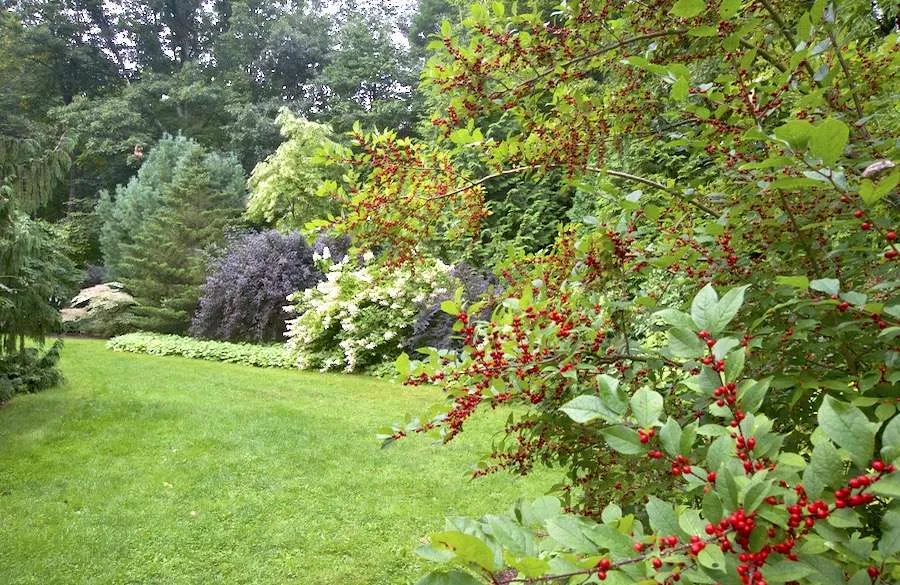
But I can say for sure that it works, because I don’t know who told me early on that for certain kinds of birds, fruiting shrubs were really good. And I planted 40 winterberries [foreground, below] and a lot of Aronia and elderberries. And I don’t know, it’s like I don’t even remember who the person was who told me that. And boy, oh boy, do I, every year since—the same patterns of the same various kinds of thrushes and the cedar waxwings. And the same birds—it’s like the pit stop for pre-migration or during the winter months to see if there’s anything left to eat at Margaret’s [laughter].
And again, I anthropomorphize and I make it a joke because that’s how it makes me happy, speaking of joy and hope. I feel like I want that kind of connection with them, but it’s true. It works. It really works.
 Becca: Yeah, it really does. Yeah, you really are. And I think you articulate this, too, in a lot of your work. The birds are one of my favorite show-ups when we do this work, but there’s just so much other life that-
Margaret: Oh my goodness. Yeah.
Becca: We’re really recreating food webs. That’s part of the joy of this effort is we’re recreating food webs that have been highly disturbed and in some cases eliminated from our landscapes.
Margaret: Yeah. No, it’s really true. It’s fascinating. So if you were going to—from your own 20-however-many years of gardening experience and all of your bird experience and your science education and all of it, your career—if you were going to say what the things are that have been the most impactful, the most powerful, what are some of the things that people need to think about that are going to move the needle, so to speak, for the birds?
Becca: One thing I want to say is, no matter how big our properties are, although I suppose if you have an immensely large property, you might be able to sort of be a part of bringing certain bird species back. We recognize that birds are living in these very complex…sometimes migrants or even regional birds travel big distances. So we’re not talking about being able to save the birds ourselves, but we’re talking about being a part of a group of people who can make intentional steps and changes to do better by birds. And so I just want to be careful about that, because of course the Cornell Lab wants to have huge impact. But as an individual property owner or in our communities, we can have some impact and as you articulate, you’re going to see immediate results from that.
But in terms of my own experience on my own property, and I do have a big piece of land, which is wonderful, I agree with you. I think shrubbery is a missing layer in a lot of landscapes, especially I would say more traditional suburban and urban landscapes.
We tend to have trees and we tend to have flower gardens. And there’s this middle layer that’s incredibly important for a whole wealth of songbirds in particular for nesting, for foraging, for bees, right? The flowering aspects of shrubs is incredibly important. And anytime you bring in pollinators, you’re going to be supporting birds, right? They’re just connected to each other. So I would say investing in a shrub layer, if people don’t have that as a part of their landscape, is incredibly important.
I also thinking about the safety of birds and the perspective from what birds need in order to feel safe and secure. And so having places that birds can escape to for shelter, sometimes that’s shrubs, sometimes that’s trees, sometimes that’s brush piles. Sometimes that’s just allowing our landscapes to have kind of a variety of layers and structures to them because different birds will respond and react differently. But ultimately, bird safety is right up there with our landscapes.
And of course, the plants themselves need to be native, right? Native habitat is critical for birds. One of the parallels with bird populations that we’ve seen is this decrease in insect populations, and insects need native plants. So the more we’re putting natives back into the ground, we’re hopefully going to positively impact those insect populations, which will help birds.
And then of course, minimizing how much disturbance we’re creating to these spaces, right? So if you plant a beautiful garden, you don’t want to be applying chemicals and pesticides to manage maybe some ants that you’re concerned about kind of getting overpopulated, right? So it’s not just what we put in the ground, it’s how we manage it. So minimizing our applications of anything that could get into the food webs and ecosystems of these birds, putting out water, keeping that water clean because all birds need water.
So you’ll get your neighborhood songbirds using that, but you also will get some special visitors who maybe don’t come to bird feeders or maybe won’t be using some of the native plants.
And also protecting our windows. That’s another top one. So as a part of our work, we’re not just talking about the garden landscape. We’re talking about how do we create spaces that are safer for birds. And if you have a beautiful native garden right in front of your windows, but that window is not visible to the birds, there’s a very good chance they could collide into it. So really thinking bigger picture, holistic, about birds is kind of where I’ve spent a lot of my time and where this project is trying to move people.
Margaret: Right. So if you have ants, I recommend getting a flicker—as in the woodpecker [laughter].
Becca: Yes. Right?
Margaret: They’re really good with ants.
Becca: They are. They’re great anteaters.
 Margaret: They’re hilarious. Yeah. And people might’ve heard what you said earlier about the shrub layer. They’re like, “Oh, but where am I going to put that? My place is full, whatever.” And it’s like, if we look at our properties differently, even a small typical suburban lot, think about that you may be mowing to the edge like right now, the edge adjacent to a neighbor or adjacent to the street, the sidewalk or whatever. It’s not really the most-used spaces, right?
You probably don’t want to put your patio furniture on the 10 feet right before your neighbor’s house or 10 feet before the sidewalk. So couldn’t that become a shrubbery, right? Couldn’t that become that sort of edge habitat, that diverse space? And maybe there’s some perennials underneath it, some groundcover-y sort of wild ginger and ferns and who knows what is underneath it and Tiarella, whatever, depending on where you live.
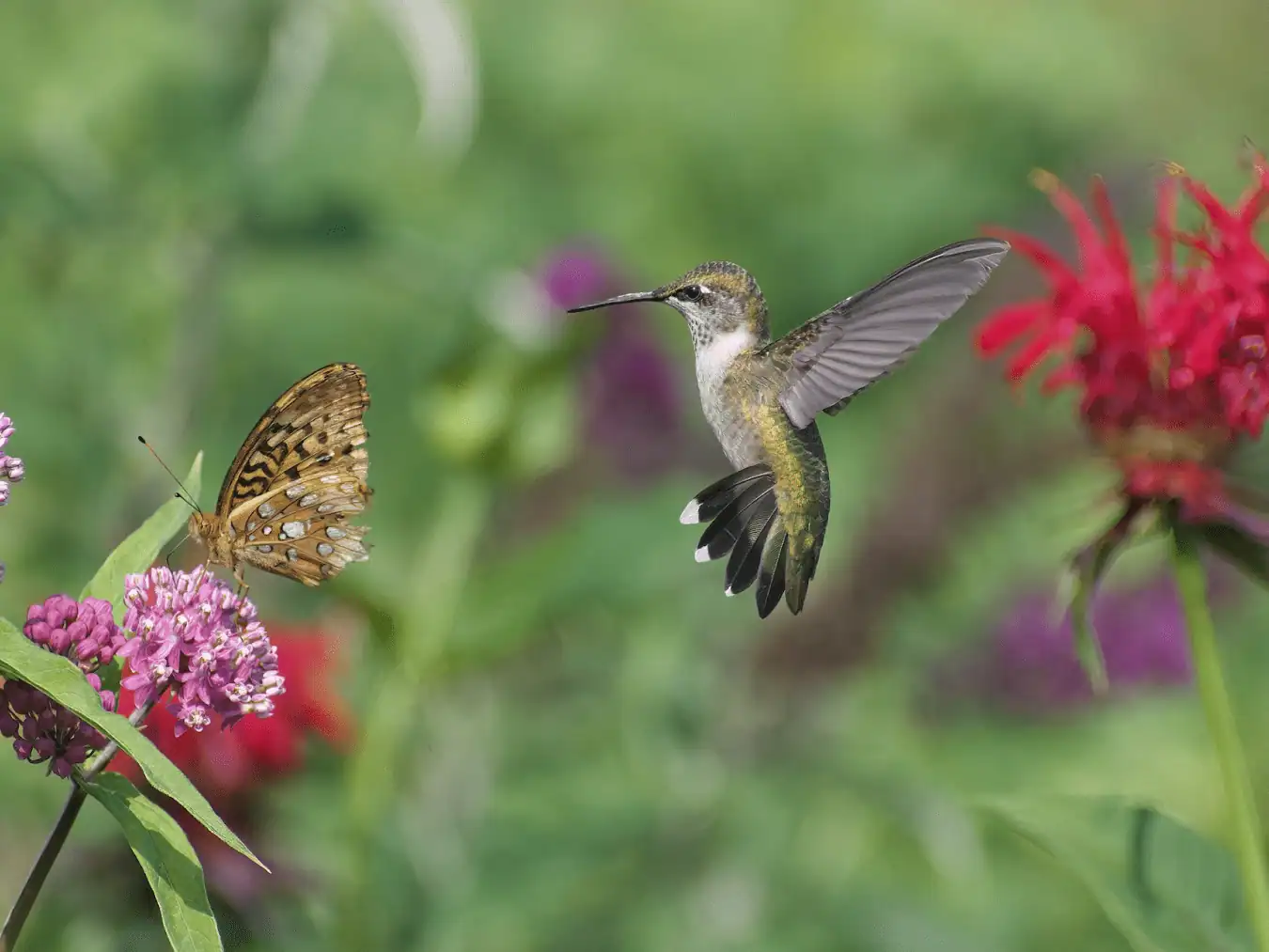
And suddenly it’s like, wow, you gave up a 10-foot strip or a 6-foot-wide strip that wasn’t really doing anything, and you have this huge high impact. And when the shrubs, as the example I used earlier, have not just flowers earlier on, but have fruit later, oh my goodness, oh my goodness, right? (Above: Ruby-throated hummingbird approaching a butterfly perched on swamp milkweed (Asclepias incarnata) in Connecticut by Michele McDermott / Macaulay Library.)
Becca: Exactly. And I noticed on your property, too, and I do it similarly on my property, sometimes even looking in front of … If you do have trees, even if you have an individual tree that sort of marks your front yard, or perhaps you have a little bit of a property line, just right in front of those shrubs or in front of those trees, shrubs grow really well.
A lot of our shrubs, especially in the Northeast, and this is true in many places where shrubbery is common, are very relatively shade-tolerant. So a lot of them are designed to sort of be next to trees. And so then you start to create this layer right in front of your tree habitat, whether it’s a single tree or line of trees that actually goes a long way to helping birds.
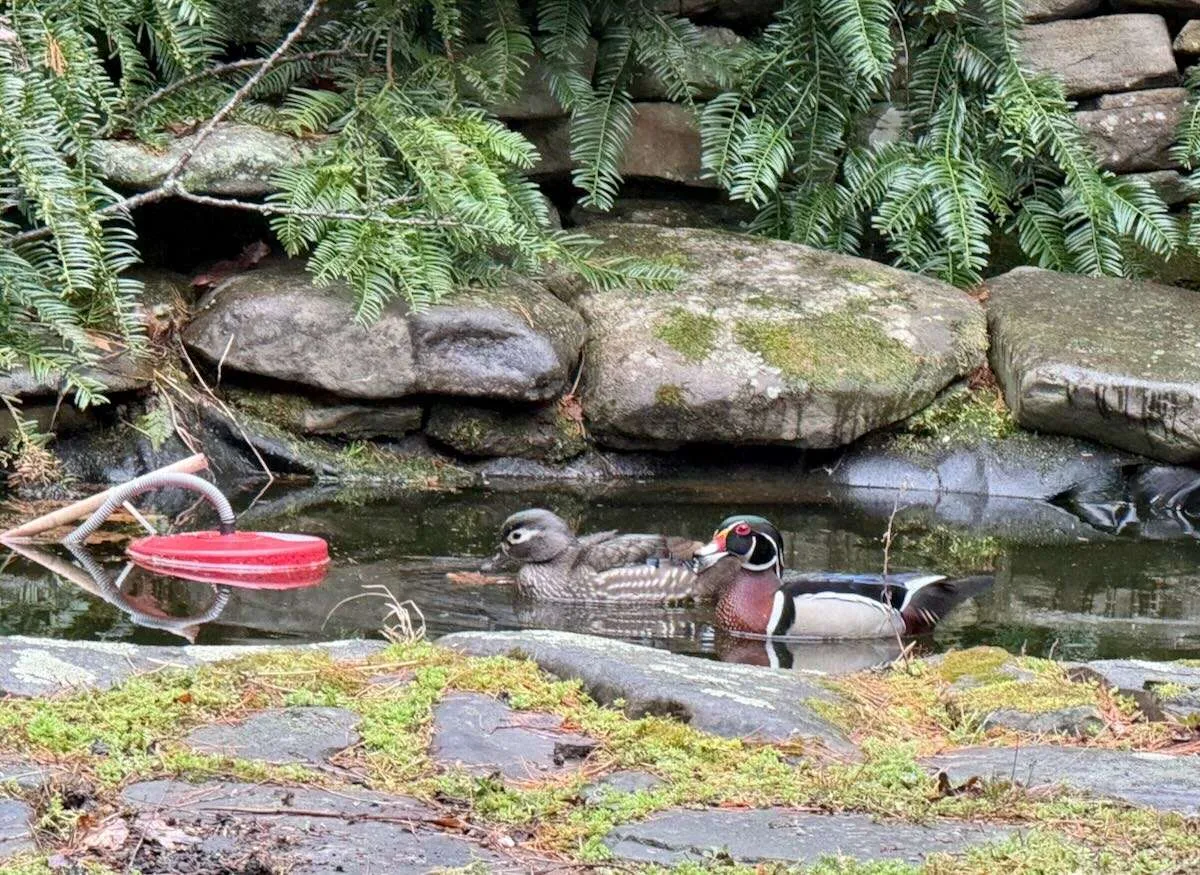 Margaret: Yeah, no, I think that’s absolutely true. And you mentioned water, and of course, and I shared this with you by email last night or this morning: I’ve had this water garden that I made maybe 35 years ago in the backyard. It’s not very big. Maybe it’s 12 feet long by 6 feet or 7 feet wide, 3 feet deep, in-ground. I keep the water unfrozen even in the winter. And everybody, I’ve had everybody from bobcats and bears and you name it to this last week, a mating pair of wood ducks [above].
Now, for me in my backyard to have wood ducks, it’s ridiculous, because I’m not in a watery habitat, I’m not in a wetland habitat, but they scoped it out and then they came back this morning, they’ve been coming back. So maybe they’re nesting at the perimeter. I don’t know. Now I’m going to have to watch and really watch them and see if I can see where they’re going.
So they found this little water resource and it’s hilarious. Now that’s not why I dug it. It wasn’t my intention, but look what happens, right?
Becca: Exactly.
Margaret: Water is just the biggest draw of all, I think, for animals. And speaking of insects, which are such a substantial part of the food web, so many insects require water to reproduce and so forth. Yeah, it’s very powerful.
Becca: Exactly. And just like those wood ducks, like you say, chances are your pond is gorgeous and beautiful, but it probably is not large enough to support nesting wood ducks [laughter], but that was a special stepping stone, stopover place for those birds, right? Perhaps they were in the middle of some kind of a big movement and they saw your pond and they said, “O.K., we just need to land and recoup a little here.” So our properties can do that even on a small scale. We can be that sort of stepping stone to the next place that birds are heading.
Margaret: Yeah. We’ll see. I mean, again, they may be nearby somewhere. Who the heck knows what they’re doing? My neighbor was very angry because she has wood duck boxes and of course nobody’s in them except some mice right now and the wood ducks are down here [laughter].
So that’s funny. Yeah. And the other thing is that I think sometimes … I don’t know if you think about it, but I also think about all the different seasons that it’s not enough to just provide … I mean, the plants are super important because they provide sustenance in so many ways, but you said “habitat features” earlier.
And habitat features, including shelter, including, again, these thickety kind of—again, I’m going to go back to the shrub layer—these places that are … And having some evergreen plants, I think is important. Where do you see the birds in winter, other than if you have a feeder out, but sometimes they’re in the evergreens, right? They’re taking cover, so to speak, getting a little bit of a buffer from the wind. And so I think it’s also … I wonder if there are places like in your garden that you’ve thought of that way, like shelter.
Becca: Absolutely. Yeah. We have a beautiful dense line of spruce, our property, and that is where … and cedars; we have another section that’s cedars. And that is where I do see a lot of birds, especially the winter we’re just emerging from in the East was brutal, right? And these birds are out in it 24/7.
So that shelter’s incredibly important, in addition to tree snags, right? I have a couple of really big snags on my property and the birds will hunker into those trees during storms.
Sometimes they’ll use my nest boxes. I often will make sure my nest boxes have some old season-before material in them in the wintertime and they can hunker down into my nest boxes during big storms, too. So yeah, taking a step back and thinking about what would I need if I was outside in the middle of a wicked storm, shelter is at the top of that list.
And evergreens are probably the best for shelter, just because they’re so dense and the birds can get in along the trunk. And birds—a lot of people don’t realize this—many, many species of songbirds huddle in the winter. So when those major storms hit, even if they forage separately, they will often congregate into the trees and sort of insulate each other.
And sometimes different birds will be on the outside. You see this with … Have you ever heard of the king penguins and how they kind of rotate? Songbirds do something similar, right? “O.K., you’re on the outside tonight. I was on the outside last night.” But it is phenomenal how these animals can exist year round in the elements that occur outside. It’s actually quite impressive.
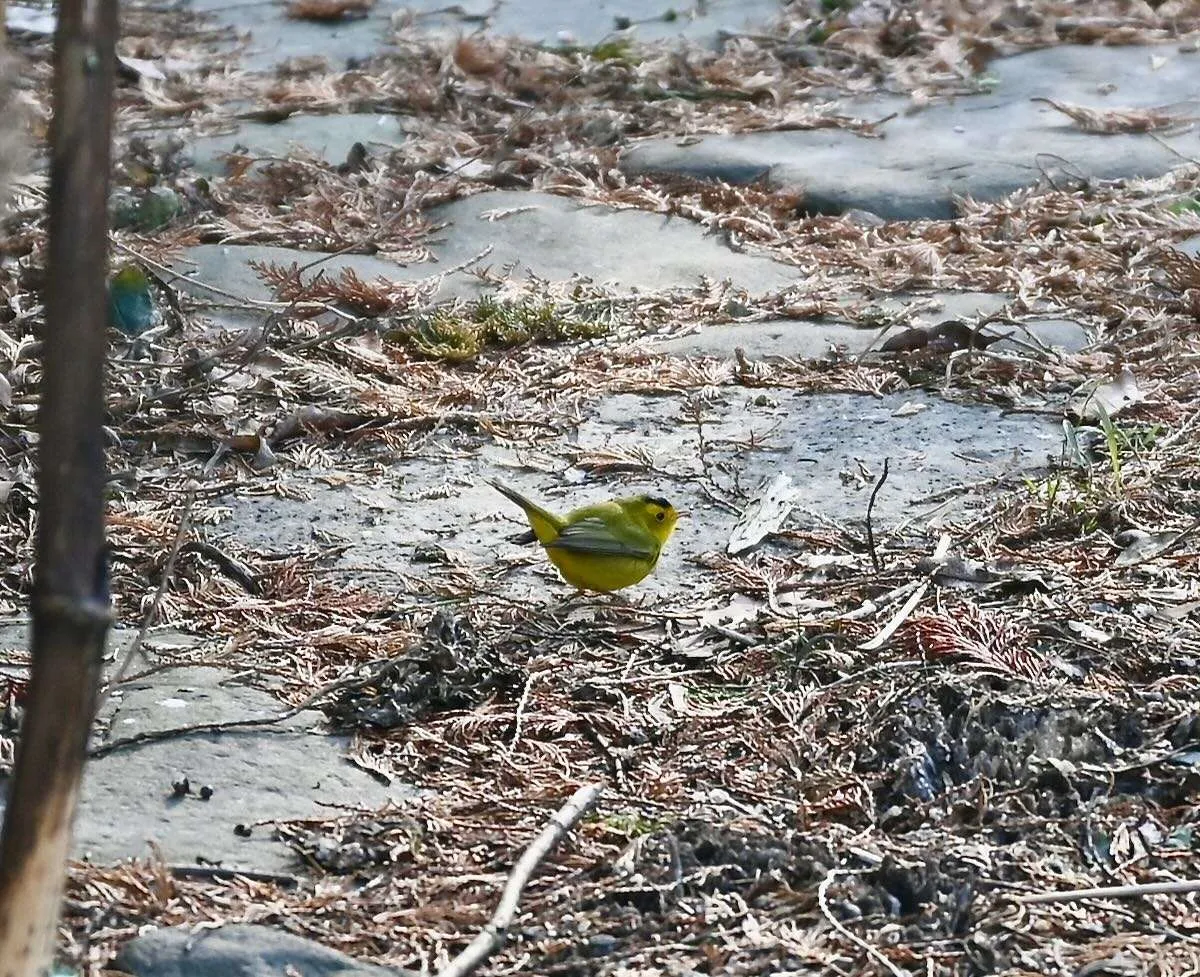 Margaret: I was just wanting to tell you a quick story—speaking of shelter and the winter. Sometimes there will be crazy storms during the migration period and you’ll see, or I’ll see a bird who, I guess, got knocked off course or something who I don’t think is supposed to overwinter … Well, I know it doesn’t typically over winter here, but did.
Like for instance, two winters ago, I had a male Wilson’s warbler who spent the winter [above]. And these birds, speaking of … Again, you’re saying how tough they are and they’ll strategize how to survive. I mean, this little guy, he’s not a seed eater or “feeder bird” or whatever, but he figured out what to do. He saw everybody else and there’s the water right near where the feeder is and that’s unfrozen. And he toughed it out. I mean, I don’t know what happened once he left late in the winter, but it’s so amazing to see them utilize these features.
Becca: Yes. And that’s a really excellent point, too, right? Obviously, one bird doesn’t make a trend or a pattern, but when we have resources on our properties to support these birds that sometimes, quite frankly, they just get thrown off in a big storm when they’re trying to get where they want to be or need to be for the wintertime. And so they do sometimes stay.
We had one where I live, we had a varied thrush. Talk about way off course, right? They’re normally on the West Coast, so it was way off course, but just like your warbler, it was utilizing a property around here that had the resources it needs. So even that small impact, I don’t know about you and your listeners, but I gather that many people who are listening to this, that feels good, right? That we can have that impact where we can give birds a chance to sort of recoup and find what they need and hope that their natural migratory instincts kick back in once spring hits.
Margaret: Well, and I think in your bio on the Garden For Birds Project website, you say something about that creating habitat for birds is “my heart work,” you say. And that’s what I think we’re both speaking about right now. There’s just nothing like it when you have the privilege—and I really do believe it’s a privilege to see something like those accidental or whatever we would call them, the birds that have gotten knocked of course, and just to see that they make it a little longer and hopefully go on when the weather changes and make it longer term. I mean, it’s just wonderful.
Becca: It is. It’s a gift. It’s a gift to be able to just see it right out your own windows. And that’s the magic that I hope as people engage in this work, that magic just continues to grow, that it’s right there. It’s your own little nature preserve.
Margaret: So we’ll give all the information about how people can sign up and they’ll get, as I said, a monthly newsletter and other resources that are there. There are some before and after pictures. Are people submitting those? Is that how that’s working or …
Becca: So one of the feedbacks we got is people really are inspired to see how quickly things can change over time. So we invite people to submit pictures. Last year we focused very specifically on before and after images, but this year we’re kind of expanding that. You could submit your wood ducks if you wanted, and we’re having people each month submit sort of a theme. And so nesting birds is the theme for April. And in March it was pictures of planning. How are you planning to engage in some habitat changes this year? So we’re doing thematic picture submissions that people love to see what other people are doing. It’s a lot of fun.
Margaret: I’ll give people some of the links to various parts of the website that I found the most interesting because again, there’s places to find the right regional plant lists and all kinds of interesting things. So Becca, thank you for making time today and happy communing with the birds in the spring and beyond. I’ll talk to you soon.
Becca: Thank you, Margaret. Lovely to be in conversation with you.
more from cornell lab
 MY WEEKLY public-radio show, rated a “top-5 garden podcast” by “The Guardian” newspaper in the UK, began its 17th year in March 2026. It’s produced at Robin Hood Radio, the smallest NPR station in the nation. Listen locally in the Hudson Valley (NY)-Berkshires (MA)-Litchfield Hills (CT) Mondays at 8:30 AM Eastern, rerun at 8:30 Saturdays. Or play the April 6, 2026 show using the player near the top of this transcript. You can subscribe to all future editions on iTunes/Apple Podcasts or Spotify (and browse my archive of podcasts here).





FYI — So cozy — makes me want a cup of tea and a quiet afternoon ☕. Will try it.
PS · Such a warm note about “garden for birds, with cornell lab’s bec” — lovely. Will try it.
PS · Such a warm note about “garden for birds, with cornell lab’s bec” — lovely. Will try it.
PS · Such a warm note about “garden for birds, with cornell lab’s bec” — lovely. Will try it.
PS · Such a warm note about “garden for birds, with cornell lab’s bec” — lovely. Will try it.
Small note · This tip on “garden for birds, with cornell lab’s bec” is so useful — thanks for sharing.
Also • great reminder — I’ll keep that in mind. Great share.
Small note – This is a small change with a big impact — thanks! Love this!