
This is part of a series with Perfect Earth Project, a nonprofit dedicated to toxic-free, ecological gardening, on how you can be more sustainable in your landscapes at home.
“One must have a mind of winter,” wrote Wallace Stevens in “The Snow Man” and after blizzards and record-breaking frigid temperatures in the Northeast this past month, it’s been hard to think of anything else. But for many gardeners, winter is often the neglected season—the one spent mostly indoors, flipping through seed catalogs, dreaming of spring. But there’s so much to be learned—and enjoyed—from the winter landscape. We spoke with Leslie Needham of Leslie Needham Design; Rashid Poulson, director of horticulture at Brooklyn Bridge Park; William (Ned) Friedman, director of Harvard University’s Arnold Arboretum; Edwina von Gal, and landscape designer and founder of Perfect Earth Project about what they love about the season, and what it can teach us all.
Let the winter vibe be your guide.
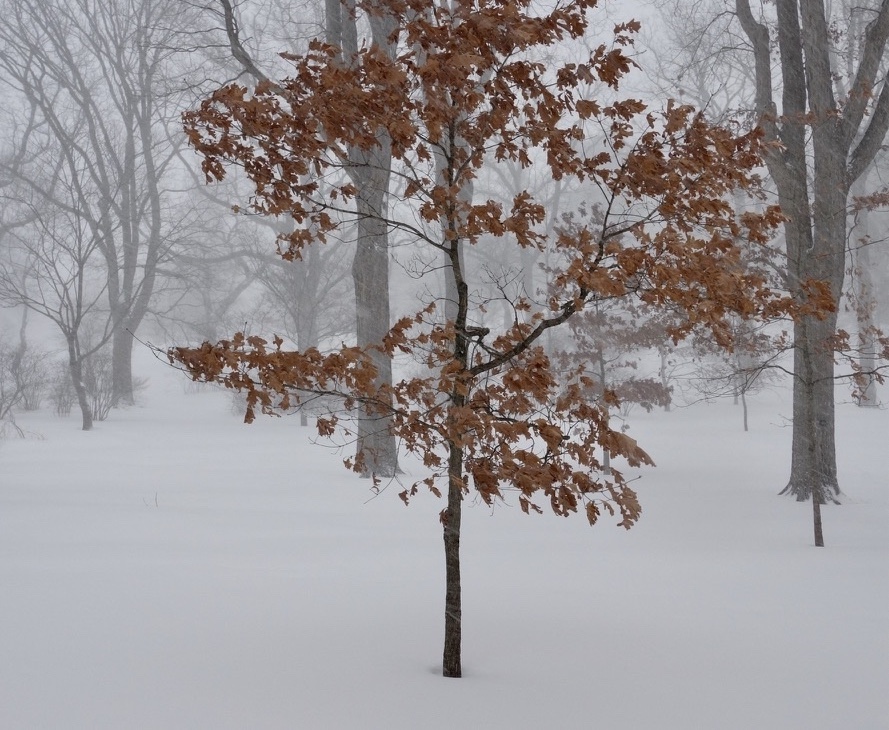
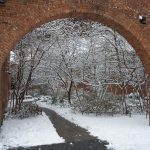
Above: “Winter is the time to slow down, reset, and get in sync with nature. I think it’s just as beautiful as spring and summer. It just requires a slight shift on what constitutes beauty,” says Needham. “There is such beauty in the structure of a tree or a seedhead in winter. You really notice them when they’re set against the white snow.”
For landscape designer Leslie Needham, winter is a time to rest, slow down, and engage with the garden. “I really love the quietness,” she says. “When plants are blooming, there is so much action. It’s go, go, go all the time, but in winter, I can really appreciate the small things.” She notices the structure of the garden and loves the beauty of seed heads framed against a bright blue sky. It helps her rethink how she approaches gardening. “I’d love to shift the way we think about nature. We should be less controlling and try not to manage it so much,” she says. And winter, when there is less to do, teaches us this. “It is a time for quiet engagement, to sync up with nature, and appreciate its beauty and embrace it throughout the year.”
Look out for where the wild things are.
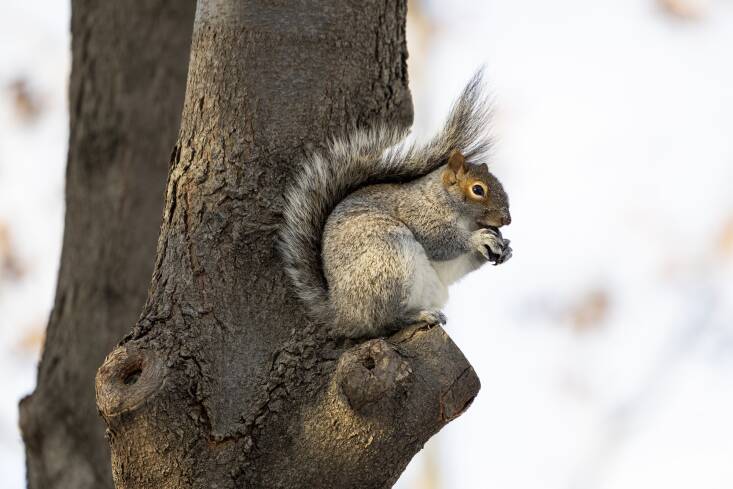 Above: An eastern gray squirrel eating acorns from its winter stash. Just a couple of weeks ago the horticulture team at Brooklyn Bridge Park noticed the squirrels making use of the subnivean zone (the area between the snow and the earth) while they were pruning native Carolina roses. Photograph by Alexa Hoyer.
It may seem quiet but there is life all around. Insects are overwintering beneath leaf piles and in stems, some emerging when the temperature rises, others waiting until spring. Winter birds and animals are foraging seeds and berries from plants and taking shelter. While tending to the Carolina roses a few weeks ago, Rashid Poulson, the director of horticulture at Brooklyn Bridge Park, and his team observed the subnivean zone, the insulated area between snow fall and the ground that is an important habitat for mammals, in action. “A colleague was standing on banked snow along the berm, pruning the native rose, when all of a sudden the snow gave way and he fell in to his knee,” Poulson recalls. “A few minutes later, four squirrels came dashing out of the hole he made in the snow. We were all in awe.”










A nice idea for the season — perfect timing. Love this! 👍
Tiny tip — Exactly — I was thinking the same thing. Great share.
Tiny tip — Exactly — I was thinking the same thing. Great share.
A lovely idea for the season — perfect timing. Will try it.
On a similar note — So cozy — makes me want a cup of tea and a quiet afternoon ☕. Saving it.
Tiny tip — Good call — that’s worth trying. Great share.