
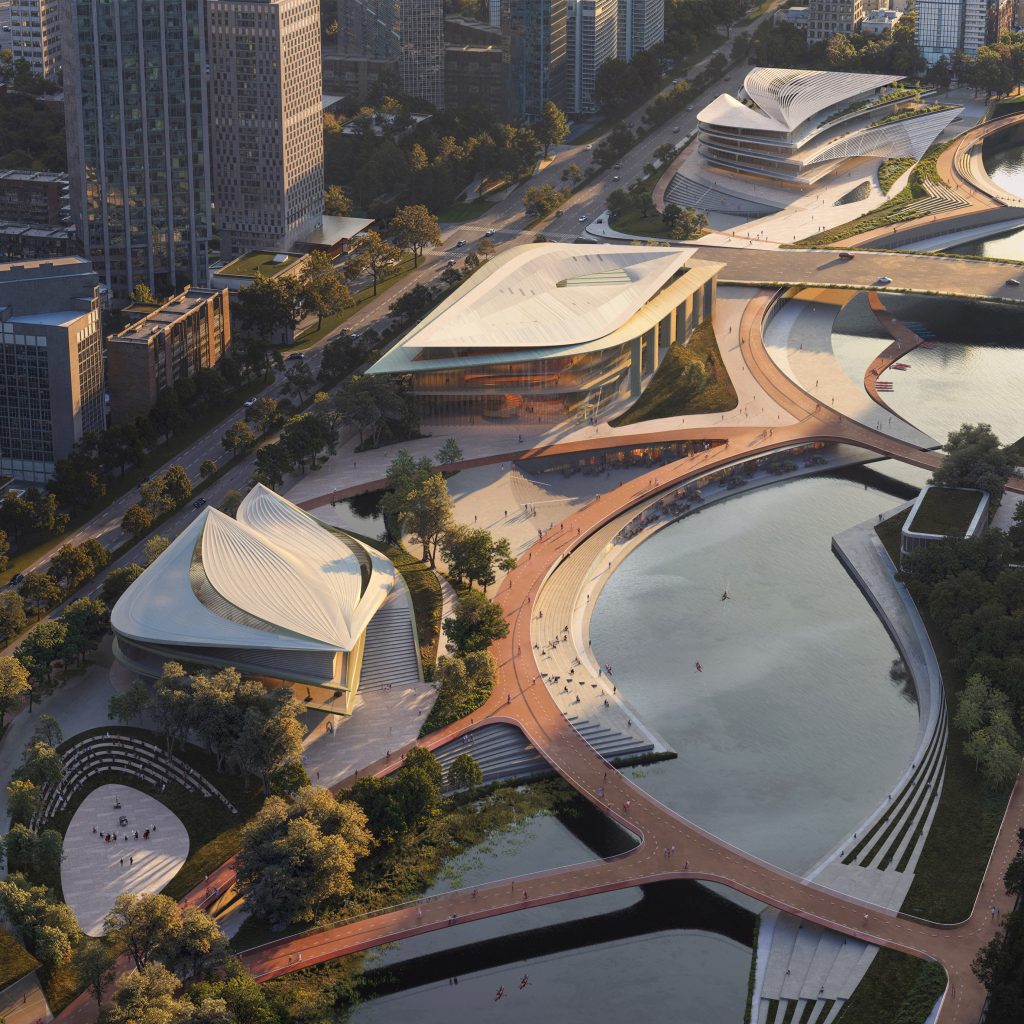
A series of sweeping public buildings are set to make up the Qiantang Bay Cultural District designed by UK studio Zaha Hadid Architects along the Zhedong Canal in Hangzhou, China.
Designed by Zaha Hadid Architects, the development will contain cultural and educational buildings, including a library, youth centre and museum, framed by landscaped parklands, plazas and performance spaces.
A gallery, music hall and fitness centre will also be built as part of the development.
Zaha Hadid Architects has designed a cultural district along the Zhedong Canal in Hangzhou
Renders of the proposal reveal a trio of sculptural waterside structures flanked with planted outdoor space and steps down to the canal.
A network of bridges and paths are set to weave through the site to connect both sides of the canal and the surrounding city with the new district.
“The Qiantang Bay Central Water Axis creates a series of new landscaped parklands, terraces and gardens along the Zhedong Canal – redefining the former industrial areas of the canal basin into a new green corridor and that weaves through the heart of the city,” the studio said.
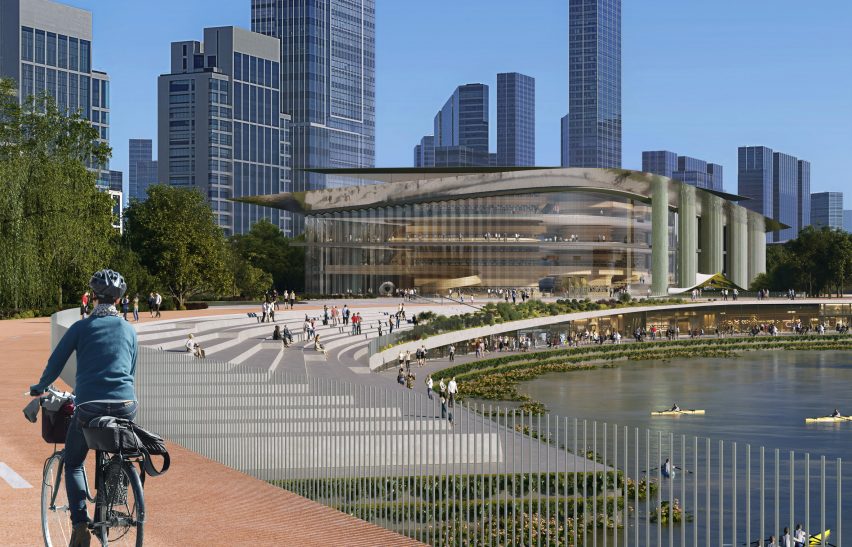 The district will include a library, youth centre and museum. Render by Atchain
Zaha Hadid Architects drew on Hangzhou’s terrain for the buildings’ sinuous designs. This includes a glazed library volume, which will be framed with large “inhabitable architectural columns” set to double as storage and reading spaces for visitors.
“Serving as structural support and defining the institutes identity as assembled ‘stones of knowledge’, these columns will accommodate the library’s extensive literary collections and archives,” the studio said.
“Sinuous structural system” supports Hangzhou footbridge by Zaha Hadid Architects
Externally, the library’s facade will be fitted with folded glass elements to draw natural light into the interior, paired with masonry tiles informed by the region’s jade artistry.
Renders of the building also reveal a shiny underside to the overhanging roof, and curving wooden structures on the interior.
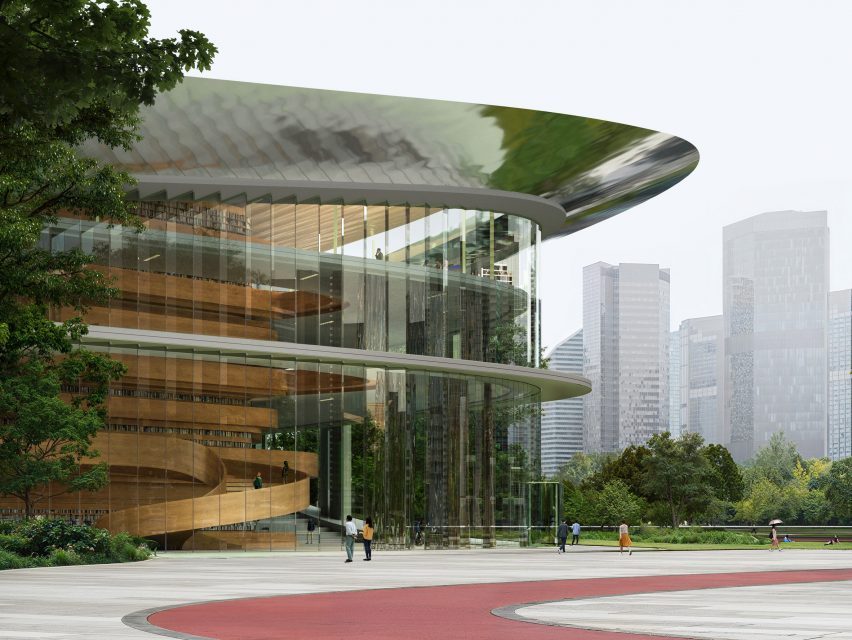 The library will have “inhabitable architectural columns”
Alongside this, the International Youth Centre will have a tiered, terrace-lined structure influenced by the adjacent waterfront.
According to the studio, the building’s facade geometries will extend to its “carved interior”, where auditoriums, studios and event spaces will cater to the city’s students.
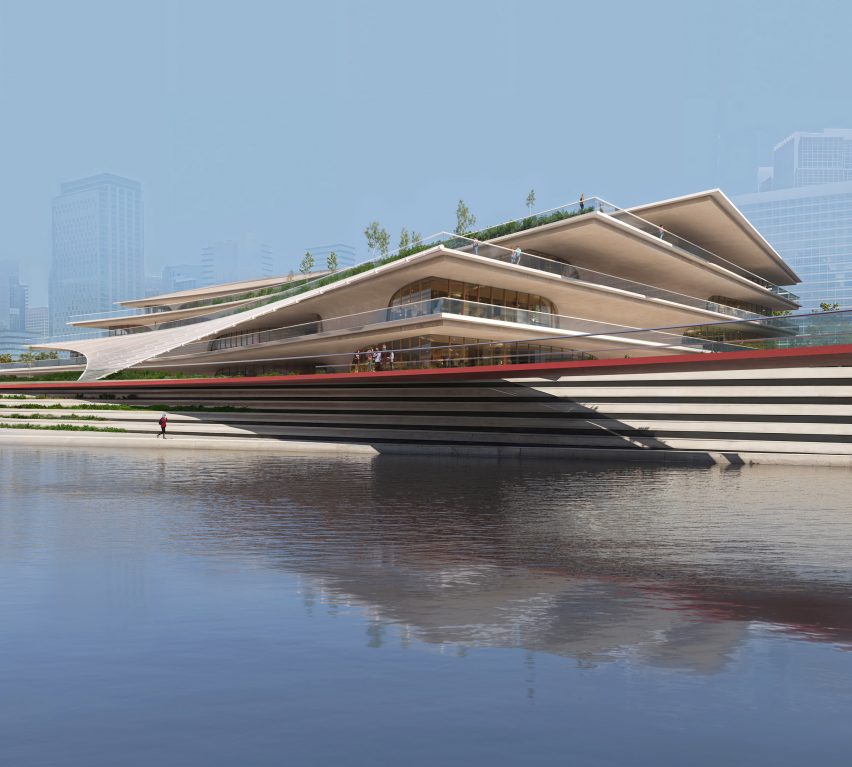 Terraces will wrap around the International Youth Centre
Throughout the development, flood-prevention strategies influenced by Hangzhou’s existing sponge-city infrastructure will be implemented.
Landscaping strategies will include permeable surfaces, planted swales and water-retention features for stormwater management.
Also in Hangzhou, Zaha Hadid Architects recently completed a curving footbridge that weaves around a trio of arches and Aedas completed a loop-shaped museum on an artificial island.
The renders are by Proloog unless otherwise stated.














On a similar note · Great step-by-step — I’ll give this a go this weekend. Great share.
FYI – Loved this about “Zaha Hadid Architects designs district o” — such a great idea. Love this!
On a similar note — This tip on “Zaha Hadid Architects designs district o” is so useful — thanks for sharing. Thanks for this! 😊