

Pests and Disease
Swiss cheese plants: a concise orientation before we get practical.
Swiss cheese plants: Quick notes
Monsteras are sturdy. They aren’t delicate and in need of pampering to stay healthy (okay, except for the rare ‘Albo’ cultivar).
Pests
In my experience, pests are the problem on houseplants more often than diseases. You should become familiar with the following insects, because they’re extremely common.
Having no natural predators indoors, these insects can reproduce rapidly.
Aphids
Where there are plants, there are aphids. Unless you have a very young Swiss cheese plant, it’s unlikely that these pests will cause much trouble.
Signs of an infestation include yellowing and drooping leaves. Examine your Swiss cheese plant and look for tiny pear-shaped insects that may or may not have wings.
To control them, place the plant in a shower or tub, and spray the foliage and stems with water to knock the bugs loose. You might have to do this once a week for a few weeks.
If that’s not working, break out the neem oil or insecticidal soap. You’ll need to spray your plant with it once every week or two, as long as the pests are present.
Scale
The most common species on indoor plants is brown scale (Coccus hesperidum).
These are flat, brown, and they cluster on the stems, sometimes venturing onto the leaf surfaces.
When they infest a plant, you’ll see leaf yellowing and stunted growth. New foliage will be slow to emerge. It won’t fenestrate, and it won’t grow as large as it should.
If you are the patient sort, this is a fairly easy problem to remedy. You can remove them with cotton swabs dipped in rubbing alcohol.
In the case of large infestations, prune away the worst affected leaves and spray with insecticidal soap.
Learn more about scale in our guide.
Spider Mites
Red spider mites (Tetranychus urticae) are itty-bitty, so it’s unlikely that you’ll know they’re there until you spot fine webbing on your Swiss cheese plant.
If you water your plant well and keep the area humid, visits by these pests aren’t common.
You can rinse them off, as you would do with aphids. If none of that works, break out the insecticidal soap.
Learn more about spider mites here.
Disease
Diseases aren’t at all common but you can’t rule out the possibility of infection entirely. Be prepared to deal with the following, just in case:
Anthracnose
Caused by fungal species in the Colletotrichum genus, this disease causes the leaves to start to yellow on the margins before turning entirely yellow and dying.
You might also see yellow coloring or lesions on the stems.
Use a copper spray designed for use on indoor plants. Apply it according to the manufacturer’s directions, spraying once a week or every 10 days.
If the problem still won’t go away, a product containing Bacillus subtilis can be extremely effective. CEASE is perhaps the most well-known of these.
CEASE Biofungicide
Apply the beneficial bacteria twice a week by spraying the leaves and stems thoroughly.
You can find CEASE available at Arbico Organics.
Bacterial Leaf Spot
Bacterial leaf spot is caused by a wide range of bacterial species, but these are usually in the Pseudomonas or Xanthomonas genera.
It typically appears as small brown leaf spots. These spots generally appear in small clusters at the center of the leaf.
Sadly, there isn’t an effective treatment available. But if you are diligent about pruning away any symptomatic leaves, you can generally eliminate it.
Root or Stem Rot
Rotting roots or stems can be caused by two problems: overwatering and pathogens.
Overwatering drowns the roots, depriving them of oxygen, and essentially smothering the plant to death.
Fungi and oomycetes in the Pythium, Rhizoctonia, or Fusarium genera can infect the roots can cause them to rot.
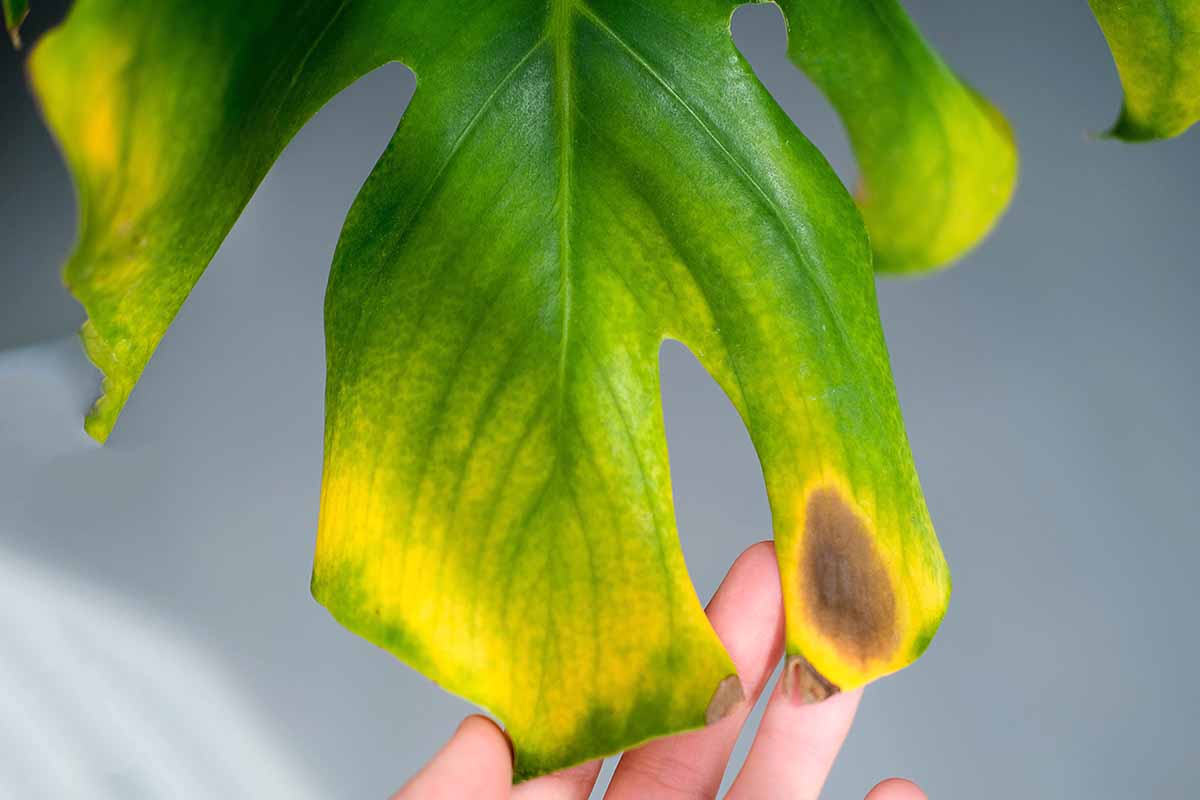
You’ll start to see dark spots on the margins of the leaves. These spots grow larger until the entire exterior of the leaf is a sad brown and yellow color.
After that, the leaves die, and the entire plant can even die if a case of rot is severe.
First, trim away any impacted leaves. Remove your plant from its pot. Brush or wash away as much soil from the roots as you can.
A short mention of Swiss cheese plants helps readers follow the flow.
We reference Swiss cheese plants briefly to keep the thread coherent.












Such a warm note about “How to Grow and Care for Swiss Cheese Pl” — lovely. Love this!
On a similar note — Such a gentle approach — I really like it. Saving it 👍
Such a warm post; this made me smile. Thanks for this!
Tiny tip — So true — this connects with me. So cozy.