
Indoor plant pests: a concise orientation before we get practical.
Indoor plant pests: Quick notes
When I spotted a scale insect on a leaf of my Thai lime tree recently, I sighed. It’s only December; sometimes they show up only in March. We must coexist indoors for another five months. I had been led to peer closely at the tree’s leaves by a tell-tale spattering of sticky honeydew beneath one branch. Above it, two branches up, I found the culprit, the pale brown dome of a mature scale insect. Wondering what other indoor plant pests are vexing the houseplant community, and how they deal with them, I consulted Darryl Cheng, Toronto-based creator of The House Plant Journal and the author of two popular books on indoor plant parenting. Darryl’s meticulous approach to growing plants is at once accessible and realistic. His engineer’s perspective to plant care includes the encouraging maxim that having a green thumb “isn’t about luck, but about being observant.”
Let’s observe. Here’s an alphabetical hit list of six of the most common indoor plant pests you may find feasting on your botanical babies: Aphids, fungus gnats, mealy bugs, scale, spider mites, and thrips—and how to deal with them.
Photography by Darryl Cheng and Vincent Mounier.
Above: Darryl Cheng’s second book is The New Plant Collector—The Next Adventure in Your Houseplant Journey (Abrams, 2024).
Darryl points out that what many of us call indoor or houseplants “are in fact tropical foliage plants” (or subtropical in some cases, like my Thai limes). Understanding how to get them to thrive in our controlled indoor climates means approximating their natural growing conditions in terms of light, moisture, and temperature. Even then, over time, they will be visited by tiny creatures that feed on them and do damage: indoor plant pests. These insects and arachnids (spider mites have eight miniature legs) may travel indoors with an indoor-outdoor plant, or (very commonly) they arrive with a newly-acquired plant. They are part of the plant’s life. And while checking your leafy family members daily may seem like a chore, it is essential for their health and “also kind of therapeutic,” Darryl says. “Think of it as detailing your plant.”
His philosophy for his own plants is that nature should be allowed to take its course. Indoor plant pests are tolerable at “the lowest level possible, as long as the plant is strong.” Here is how to keep that pest level low.
Aphids
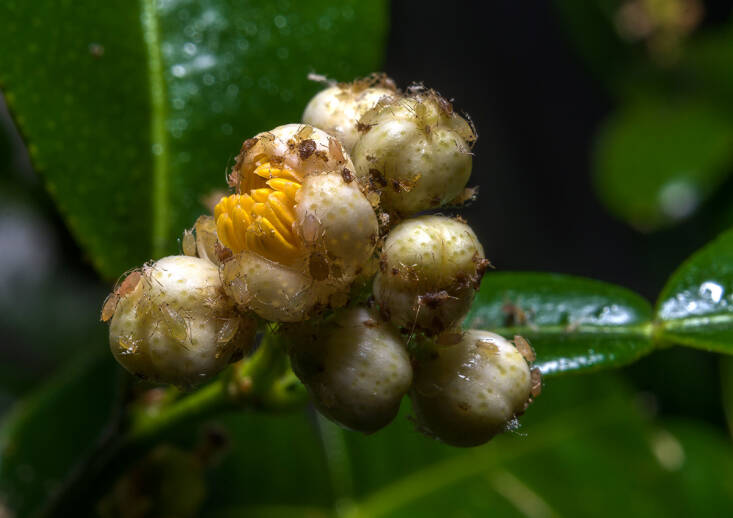 Above: Aphids feeding on lime blossoms. Photograph by Vincent Mounier.
I was a little jealous to learn that Darryl rarely, if ever, encounters aphids. This is likely because they are often an outdoor-indoor issue: In my case, these soft-bodied sap suckers travel indoors invisibly with our trees when we move them indoors for winter. While aphids are not hugely destructive, they can damage new growth if they remain unobserved for a while, as in my case, above. They can be spotted “when they congregate around the growth point of the plant,” Darryl notes.
Aphid Control:
- I deal with aphids by squishing them. Gross, but effective.
- I also spray them with a mixture of water and dishwashing liquid (1/4 teaspoon in 16 fl oz/2 cups)l; the soapy coating smothers them.
Fungus Gnats
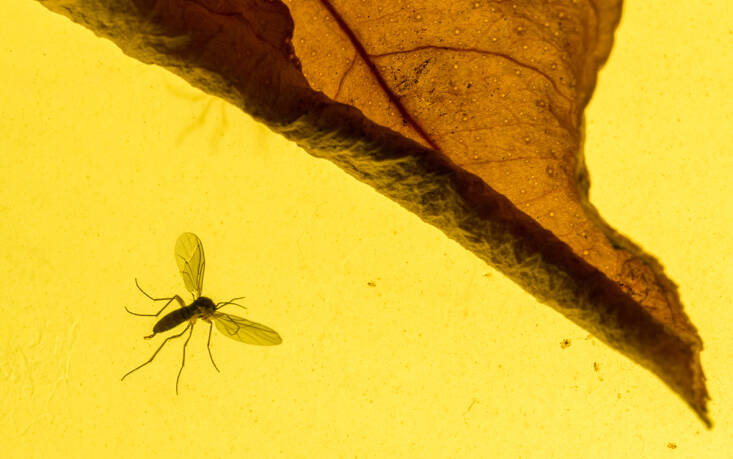 Above: A fungus gnat immobilized on a yellow sticky trap (dead leaf for scale). Photograph by Vincent Mounier.
Many online plant forums are abuzz with questions about annoying, small flying insects. Like fruit flies, but different, say the worried houseplant owners. “Fungus gnats are opportunists,” says Darryl, who does not consider them damaging. They feed on fungus that grows in damp organic material, like potting soil or bark chips. Major larval infestations may damage plant roots if no fungus is available. And while I interpret their presence as a timely warning that my potting media for citrus trees is too damp—meaning that I am watering too often—Darryl makes the point that some plants, “like maidenhair ferns,” should remain moist. So the presence of fungus gnats does not necessarily mean that there is problem: “It depends on the plant,” he says, and an understanding of the different conditions that particular plants require to flourish.











Small note: This is so satisfying to read — thank you.
On a similar note: I love how honest and practical this is. Thanks for this!